

 These accredited institutions are giving their students a competitive edge by teaching simulation techniques and principles using the same product these students will use once they graduate... ExtendSim. Future engineers (civil, irrigation, cyber security, industrial, traffic systems, biochemical, construction, mining, etc.), business professionals (health care managers, policy & process managers, risk analysts, technology managers, economists, etc.), operations managers (service ops, supply chain, logistics planning, manufacturing systems, etc.), data & statistical analysts, and others are using ExtendSim to learn how simulation can help them advance in their careers.
Join these universities and adopt ExtendSim as THE simulation tool for your institution.
update form for current Adopters 
Arab Academy for Science, Technology, and Maritime Transport
 College of Engineering and Technology
Department of Industrial and Management EngineeringAbuKir Campus, Alexandria, Eqypt
Courses ExtendSim has been used in
 Discrete Event System Simulation - IM528/IM729
Prof. Khaled El-Kilany, PhD
Student head count
10-31 Undergraduate and Postgraduate Students, depending on the semester
How ExtendSim typically is used in the course
Every aspect of simulation is taught through a set of case studies of varying complexities. The ACME Steel and the ITI ED case studies in the companion DESS e-book are among these set of case studies and are highly recommended, in addition to other set of comprehensive problems developed over the past years. Simulation parameters setting (run length, warm-up period, and number of replications); input modelling (using StatFit to fit distribution to datasets and selection of most suitable distribution); reporting simulation output (graphically using plotters and statistically using Mean and Variance and Stat blocks); and analyzing output (comparing scenarios and using Common Random Numbers). In addition to covering most of the blocks used in the item library that are useful in modelling various systems such as activities (setting capacity, random delays, delays based on attributes, and shutdown); queues (limited/unlimited, sorting items based on FIFO/priority/based on attribute, resource pool); routing (catch and throw, select item out/in based on attribute, random, and priority); resources (resource pools, resource release, and shifts); and information blocks for reporting cycle time and throughput. Also, a set of basic problems are taught in tutorials these problems introduces the development of basic reusable models that can be used by the students to model most real-life problems and would be useful when developing models for their term projects.
Student projects
During the first semester the students successfully fulfilled 6 projects. Some of the projects were based on a real-life case either in manufacturing or service. Specifically, modelling and simulation of an assembly line for car valves to determine the suitable number of operators needed to achieve an expected demand (data was collected by a student during a previous summer training in Germany), evaluating the impact of increasing resources in a dental clinic on the average length of stay of patients, and identifying the times of peak demand and waiting times in a pharmacy and scheduling pharmacists and employees accordingly. Two other groups, due to COVID-19 and country-wide lockdown, developed simulation models of the Intel Five-Machine Six Step Mini-Fab, which is a well-known problem in literature having a detailed description available online. As for the second semester, the Intel Five-Machine Six Step Mini-Fab problem was provided to 2 groups of students and both groups developed different models and scenarios for the same case.
Student projects over the years
- AASTMT Medical Services Facility • Simulation of a queueing system
- Bank • Queuing analysis
- Bread Production Line • Capacity analysis of the production line
- Cab Services Company • Optimization of the number of cars be used by the company
- Car Filters Manufacturer • Capacity analysis
- Car Spare Parts Manufacturer • Bottleneck analysis of a line within the manufacturing facility
- Carrier Air-Conditioning Factory • Analysis of cycle time
- Computer Service Center (on campus) • Modelling of different services offered and their combinations with the objective of maximizing the number of students served per day
- Fast Food Restaurant • Order processing simulation
- Gas Station • Analysis of service and performance of queues
- ISP in Alexandria • Study of a multi-channel, multi-phase queuing system for an internet service provider
- Marine Structure Fabrication Process • Optimization of resource usage
- McDonald's • Simulation of queues buildup during rush hours to determine the number of cashiers to operate
- Mobinil • Model this mobil carrier network in Egypt
- On Campus Cafeteria • Simulation of available capacity and queues
- QNB Bank (International Bank in City of Alexandria) • Simulation of different service offerings, employees schedules, and queues
- Restaurant • Queuing analysis
- Starbucks Cafe in Alexandria, Egypt • Analysis of queue buildup
- Steel Manufacturer • Simulation of cold direct reduction iron briquette system with the objective of assessing the overall performance of the system and optimizing the production rates of the different equipment used
- Structural Steel Fabrication Facility • Bottleneck analysis
- Textile Coating Line • Modeling and simulating the line
- Traffic Light Signal Analysis • Study of the duration of the different light signals on the number of cars waiting in queue
- A variety of other companies in Eqypt • Credit Agricole Bank, Dental Arts Clinic, Metro, Mobil Gas Station
- A variety of other real manufacturing systems in Eqypt • Evaluation of different maintenance plans in a sheet metal works company, analysis of traffic light signal timing, bottleneck analysis for bottled juice producer, capacity analysis of a beverage manufacturer, queuing system at a mobile service provider, and assessing the impact of adding additional filling machine in a yogurt production facility
Ease with which students learn to model with ExtendSim
Through the years of using ExtendSim in this course, students have always found it easy to develop simulation models, better understand the simulation concepts, and are always excited doing the models. I usually schedule the lecture and the tutorial back to back to give enough time to develop complete models for the case studies. A minimum of 5 case studies were covered in each semester; in addition, a set of simplified problems covering a single modelling approach or a simulation concept are done in the tutorial.
Thanks to the Adopter program, students develop their models during the lecture and tutorial with the professor and/or the TA. Once again, thanks to Imagine That, the students were able to download the free versions of the ExtendSim 10 student versions. If it wasn’t for Imagine That commitment and instant response to the COVID-19 pandemic, this course wouldn’t have been delivered in such a smooth and successful way.
Benefits attained through the use of ExtendSim
It is always much easier and more beneficial to use ExtendSim in teaching any simulation course compared to the conventional method of delivering a simulation course without any hands-on experience and/or developing the students’ practical and transferable skills. This semester I noticed several students continue using ExtendSim in their graduation projects and even apply for the ExtendSim Research Grant and successfully obtain it, which is all attributed to the knowledge and hands-on experience they gained in the IM528 course.
ExtendSim helps always in improving the students' abilities in model development, critical thinking, practical and transferable skills. They always consider this as an enjoyable learning experience and through the use of ExtendSim they grasp the basic concepts of simulation such as random number generation, setting the different simulation parameters, verification and validation... etc.
ExtendSim helped a lot in visualizing the systems under study. Various reports generated helped the students to further refine their analysis capabilities and enabled them in identifying and testing improvements to their models. It also helped Prof. El-Kilany in explaining several simulation concepts; such as, random number generation, setting simulation parameters, variance reduction techniques, and comparison of systems. Without ExtendSim, students would have never understood the importance of such concepts and their application when developing simulation models.
Rather than having a raw theoretical course about simulation with probably some spreadsheet applications of abstract problems, ExtendSim helped students in understanding the essence of simulation practice and theory and helped them in addressing more complex and realistic problems. In Prof. El-Kilany's opinion, the best aspect of using ExtendSim is the flexibility it provides in developing simulations for different situations and systems easily and its ability to model the same problem in various ways. This helps in building students' intuition and skills and helps the instructor in conveying model building knowledge in several approaches. ExtendSim is a suite that includes all the tools to successfully show the various concepts of simulation and complete a simulation study - animation, database, scenario manager, optimizer, distributing fitting, etc. Also, the libraries and blocks are very easy to deal with and develop various models.
Future plans for ExtendSim at AASTMT
Based on recommendations by ABET PE, the simulation course will be a compulsory course. So, they're expecting more students to enroll for the course at the undergraduate level. It continues to be used for illustrating several concepts in Factory Physics and Production Planning and Control courses. ExtendSim helps the students understand concepts of scheduling, production line flow control, and variability analyses; however, I use it for illustration purposes only and students are not asked to develop any models on their own in these courses.
Conference papers submitted based on models developed in this course
G. Y. Moustafa ; N. M. Galal, and K. S. El-Kilany, “Sustainable Dynamic Pricing for Perishable Food with Stochastic Demand” in Proceedings of the IEEE International Conference on Industrial Engineering and Engineering Management (IEEM2018), Bangkok, Thailand, 16-19 December 2018. Hagar H. Amer, Noha M. Galal, Khaled S. El-Kilany, “A Simulation Study of Sustainable Agri-Food Supply Chain”, Proceedings of the International Conference on Industrial Engineering and Operations Management, Paris, France, July 26-27, 2018.
Yassin M. Shaalan, Ingy A. El-Khouly, and Khaled S. El-Kilany, “Simulation Analysis of Segmented CONWIP: Application to Reentrant Flow Lines”, Proceedings of the International Conference on Industrial Engineering and Operations Management, Bandung, Indonesia, March 6-8, 2018.
N. Galal, and K. S. El-Kilany, “Sustainable Agri-Food Supply Chain with Uncertain Demand and Lead Time”, International Journal of Simulation Modelling, vol. 15, no. 3, pp. 485-496, 2016.
J. El-Zoghby, H. A. Farouk, and K. S. El-Kilany, “Discrete Event Simulation of Patients’ Flow in an Emergency Department”, in Proceedings of the 2016 Industrial and Systems Engineering Research Conference, Anaheim, California, 2016.
J. El-Zoghby, H. A. Farouk, and K. S. El-Kilany, “An Integrated Framework for Optimization of Resources in Emergency Departments”, in Proceedings of the 2016 International Conference on Industrial Engineering and Operations Management, Kuala Lumpur, Malaysia, 2016.
Nayera E. El-Gharably, Khaled S. El-Kilany, and Aziz E. El-Sayed, "Optimization Using Simulation", World Academy of Science, Engineering and Technology, vol. 78, 2013.
Sherine Beshara, Khaled S. El-Kilany, Noha M. Galal, “Simulation of Agri-food supply chain”, presented May 13, 2012 at WASET 2012 Amsterdam International Conference.
El-Kilany, K.S., "Wafer lot release policies based on the continuous and periodic review of WIP levels", presented at Industrial Engineering and Engineering Management (IEEM), 2011 IEEE International Conference.
Arab Academy - Industry Service Complex
 Operations ManagementAlexandria, Egypt
Course ExtendSim is used in
 Industrial Applications of Simulation Using ExtendSim
Professor Khaled S. El-Kilany
Type of course
Training course with 25 students
Course overview
This course is intended for undergraduate/postgraduate students, researchers, industry professionals, and entry to medium level simulation practitioners. The course covers the basic concepts and principles of simulating discrete event models of complex stochastic systems. Topics covered include the fundamentals of simulation, analysis of data, verification and validation of models, building sound simulations using ExtendSim, and designing simulation experiments. Furthermore, it offers hands-on experience relevant to the application of modelling and simulation in manufacturing and service industries.
Concepts to be taught in the course
- Input Modelling
- Queuing Analysis
- Capacity Analysis
- Modelling Multi-products flows
- Batching
- Resources
- Reporting and Output Analysis
- Setting Simulation Parameterss
- Comparing Systems
Student projects
A set of case studies varying in complexity and addressing different concepts of modelling and simulation using ExtendSim.
Arab Academy - Technical and Vocational Institute
Professional EngineeringAlexandria, Egypt
Courses ExtendSim is used in
Professor Islam Ibrahim Mohamed ElBanna
- Managing a Professional Engineering Project
- Professional Engineering Management (Target)
- Research Project
Type of course
100 students per year at Level 5 Higher National Diploma in Engineering
Course overview
Unit 35: Professional Engineering Managemen Engineers are professionals who can design, develop, manufacture, construct, operate and maintain the physical infrastructure and content of the world we live in. They do this by using their academic knowledge and practical experience, in a safe, effective and sustainable manner, even when faced with a high degree of technical complexity.
The aim of this unit is to continue building up on the knowledge gained in Unit 4: Managing a Professional Engineering Project to provide students with the professional standards for engineers and to guide them on how to develop the range of employability skills needed by professional engineers. Among the topics included in this unit are:
- Engineering strategy and services delivery planning
- The role of sustainability
- Total Quality Management (TQM)
- Engineering management tools
- Managing people and becoming a professional engineer
On successful completion of this unit, students will be able to construct a coherent engineering services delivery plan to meet the requirements of a sector-specific organisation or business. They will display personal commitment to professional standards and obligations to society, the engineering profession and the environment.
Concepts to be taught in the course
- Modeling and Simulation in Manufacturing
- Perform experiments
- Statistical Analysis
- Controlling resources and activities
- Improving performances
- Optimizing flows or cycle times
- Project Scheduling
- Strategic Development
- Research Six Sigma Process Improvement
- Assigning Equipment
- Testing the Effectiveness
- Analyzing Costs
- Launching New Prototypes
- Providing support for scheduling
- Evaluating the performance
Student projects
- Students Graduation -Research Projects
- Managing of engineering services delivery plan that meets the requirements of a sector-specific organisation
- Review commercially available project management tools/software to select most suitable
- Consideration of requirements of the chosen project, difference between systems (e.g. Prince 2) and software (e.g. PMIS, Microsoft Project, PROMIST)
- Task and tracking tools and techniques (e.g. Trello, Smartsheet, Excel)
- Scheduling and time planning (Gantt chart or similar)
- Network diagrams
- Types and applications
- Critical-path methods (PERT)
- Budget management tools Methodologies (e.g. waterfall, Agile, Scrum, Kanban, Scrumban, eXtreme programming (XP), Adaptive Project Framework (APF), Lean)
- Project management techniques (e.g. SWOT, stakeholder matrices, risk mapping, radar chart and summary risk profiles).
 APJ Abdul Kalam Technological University
 APJAKTU Schools
India
Course ExtendSim is used in
 Infrastructure Construction Management: Lean integrated
Dr. Jeevan Jacob
Type of course
Spring semester course with up to 18 students
Course overview
Lean integration to infrastructure construction life-cycle is the concept here. This course is custom made anticipating the potential of modern techniques. Simulation will be introduced to all possible lean techniques which are currently done using games and manual role play. This would be the first of this kind.
Concepts to be taught in the course
We are planning to introduce simulation as a routine work for all lean techniques.
Student projects
Prof. Jeevan Jacob was the first one to use ExtendSim in IIT Madras in 2013-'14. And he taught the simulation part for 4 years there as a part of a modelling course by Prof. Koshy Varghese. Now this is an extensive attempt to introduce it for Lean which would significantly change that domain. One it is successful, it will be introduced to ILCE which is an opening to all technical institutions of India.
Ateneo de Davao University
 School of Engineering & Architecture
Department of Industrial EngineeringDavao, Philippines
Courses ExtendSim is used in
 Systems Modeling
Prof. Randell Espina
Student head count
20
Course summary
An interdisciplinary course with a broad range of non-trivial techniques and approaches for modelling and simulation of dynamic engineering systems.
Simulation concepts taught in the course
- Discrete event model
- irst- and second-order system models
- Time
- Frequency and state space relations
- Feedback systems
Projects fulfilled by the students using ExtendSim
- Manufacturing • Food production
- Manufacturing • Electricity distribution
- Transportation • Traffic System
- Disaster Risk Management System
ExtendSim use outside of this course
ExtendSim will also be used in the Operations Management course.
Benedictine University
 College of Business
Department of Undergraduate BusinessLisle, IL USA
Course ExtendSim is used in
 Business Process Modelling - BALT350
Dr. Deborah Cernauskas
Type of course
Undergraduate, Junior/Senior level course that has grown from 15 to 32 students
How ExtendSim typically is used in the course
The class is a part of the Business Analytics major in the undergraduate program at Benedictine University in Lisle, IL. The focus of this class is on understanding how to build simulation models for business processes to determine how changes to the process will impact the process either positively or negatively. ExtendSim is the core of the course used as a basis for understanding how to model current state and modify to implement change. Students are reliant on the software to build simulation models and to get an understanding on how processes work. They learn how to evaluate, model, and restructure processes using ExtendSim. Business process analysis and improvements are modeled using the software. For example, in the Spring of 2018, students used the software to modeling business processes such as lines at an amusement park.
Student projects
Students are required to complete two projects: a team project which is presented at an in-house research symposium and an individual project that students complete and write up a report describing current and future state models. This fits with our objectives to teach students communication skills along with their technical knowledge. Many of the models created are highlighted under the ExtendSim Use in Higher Education tab on the Showcase page.
The team project is for the Benedictine Undergraduate, Research, Scholarship and Arts Symposium (URSA) which is held during the spring semester on campus. Undergraduate students present projects they have worked on in their classes. Projects have included improving the ordering process at a local restaurant.
Every student was also required to develop and write up a model that included a model of the current state process with an improved model. Students were required to include KPIs for the current and proposed state models.
Ease with which students learn to model with ExtendSim
Students like using the software and find ExtendSim easy to learn and use. Most students learned the basics quickly. The software makes learning simulation modeling very easy.
Benefits attained through the use of ExtendSim
Students learn queueing theory without having to learn all the horrendous equations typically involved. They gain an understanding of inefficiencies and bottlenecks in processes and how to find solutions. They have learned how to use a simulation modeling tool which will be very beneficial in their careers. Students do not have to write code. Most students in the College of Business do not want to write code, but enjoy building models with the point-and-click blocks. Since they can learn to use the software quickly, they want to continue using it after graduation.
Additional comments
I like the software. I find it easy to use and the students have few hurdles in learning.
Campus ESPRIT
 School of ESLI
Department of Optimisation des FluxRedon, France
Courses ExtendSim has been used in
 Flow Simulation and Optimization
Prof. Pierre Jolimont
Student head count
40 students
Simulation concepts taught in the course
Project management and sizing supply chain by flow simulation.
Projects fulfilled by the students using ExtendSim
Modeling of production and logistics processes.
Delft University of Technology
 Faculty of Technology, Policy and Management
Department of Multi-Actor SystemsDelft, Netherlands
Course ExtendSim is used in
 SEN9110 Simulation Masterclass
Prof.dr.ir. Alexander Verbraeck
Type of course
MS level with approximately 30 students
How ExtendSim is used in the course
Advanced discrete event simulation topics will be discussed. Students will learn about distributed simulation and the variety of simulation languages on the market.
Student projects
Students will be asked to compare and contrast different simulation packages and languages.
Possible ExtendSim use in other courses
ExtendSim may be used in preparation for MS theses.
Dublin City University
 Faculty of Engineering & Computing
School of Mechancal & Manufacturing EngineeringDublin, Ireland
Course ExtendSim is used in
 Manufacturing Systems Simulation - MM584
Prof. John Geraghty
Type of course
Masters course with 45 students
How ExtendSim typically is used in the course
ExtendSim is used in the labs to demonstrate and support student understanding of theory and gain practical experience in the art of simulation model development, validation, and experimental design and analysis. And, to support the deepening of their understanding of manufacturing systems' behaviour and performance.
Student projects
Weekly lab exercises linked directly to the lecture material delivered in the previous week. These as small simulation models and students submit written reports detailing the model development and the results of their study. A large individual project to develop a simulation model for an industrial problem over the course of semester is also set as challenge for the students. They can propose their own study of a system they are familiar with or select one from a list of projects provided by the lecturer.
Students typically complete 12 lab sessions on ExtendSim throughout the semester. The first five labs (based on guided tutorial exercises) are submitted for grading (20% of module grade). The remaining labs are designed to support knowledge acquisition required to complete a large individual modelling exercise (30% of module grade) based on integrating an assembly line and a job-shop environment with the goal of maximizing the throughput of the system while minimizing the work-in-process. Two reports are required, one detailing the development and validation of the model and the other documenting the experimental results and implications for the effective management of the system studied.
Ease with which students learn to model with ExtendSim
Students find the software is intuitive and relatively easy to learn basic simulation modelling constructs and concepts. They also like the flexibility within the software to leverage other developments through hierarchical modelling or to develop their own objects using ModL. Overall, feedback from the students is that ExtendSim allows them to develop models to test the limits and applicability of the the theoretical aspects of the module very easily.
Benefits attained through the use of ExtendSim
Learning the basics of how to interact with the software and develop simulation models is relatively straightforward and easily supported through the documentation provided with the software and the lab material developed by the lecturer for this module. This means that we can very quickly move from learning how to use the software to developing practical understanding of the theoretical principles of simulation that are explored in the lecture series. Students gain an understanding of the modelling environment so quickly that lab hours can be devoted to learning how to model and analyse problems in manufacturing systems rather than learning the software itself. Students engage with the module more enthusiastically. Since adopting ExtendSim many more students express interest in completing their dissertation on topics that require/could use discrete event simulation as the main modelling tool. I can easily map the theory onto very simple modelling examples that highlight the practical implications of the theory in a manufacturing environment. ExtendSim is now fully integrated into the module and all lectures have supporting labs and models that easily illustrate the theoretical concepts from the notes.
Emory University
 Goizueta Business School
Department of Information Systems and Operations ManagementAtlanta, GA USA
Course ExtendSim is used in
Healthcare Operations and Technology Management - BUS652
Prof. KC Diwas
Type of course
MBA-level elective course with approx. 35 students
How ExtendSim typically is used in the course
ExtendSim was used in an MBA-level elective course titled “Healthcare Operations and Technology Management” (BUS652) at the Goizueta Business School at Emory University in the spring semester of 2014. In this course, students apply management tools to examine the health care value chain. Specifically, we learn to analyze health care organizations using qualitative as well as quantitative principles of operations management, and develop solutions to problems that are commonly encountered. The course is organized around four key modules:
- Designing healthcare delivery options.
- Capacity planning and decision making under uncertainty.
- Process failure, learning, and improvement.
- Innovations in healthcare.
Students learn from case discussions, lectures, problem solving, in-class exercises, and guest speakers from the healthcare industry. Case settings involve the key stakeholders in the healthcare industry, viz., hospitals and clinics, pharmaceutical companies, medical device manufacturers, IT providers, regulatory agencies, and doctors and patients. Students also learn to use ExtendSim, an award winning simulation tool, to supplement our understanding of process analysis and decision making under uncertainty.
Following the first and second modules on designing healthcare delivery system, and on capacity planning and decision-making under uncertainty, students map out patient process flows using ExtendSim. The goal is to:
- develop a better understanding of the dynamics of process flows, and
- examine “what-if” scenarios involving process level changes that could impact overall performance, including patient length of stay, throughput and waiting times.
Student projects
Students were assigned a homework problem set, consisting of various problems, which needed to be modeled in ExtendSim. The goal was to develop the ability to translate a verbal description of a business problem into a discrete event simulation model, which would help to generate useful managerial insights.
Benefits attained through the use of ExtendSim
Students greatly appreciated the utility of the ExtendSim tool, and its wide applicability to a range of business problems.
European Universities in Egypt
 UCLan Branch
Operations Management DepartmentCairo, Egypt
Course ExtendSim is used in
Operations Management Module
Professor Shady Maged
Type of course
Level 5 students (3rd year) in Semester 1 & Semester 2 with 30 students
Course overview
In this module, students delve into the critical aspects of operations and process strategy, tailored specifically for the dynamic fields of mechanical, mechatronics, and motorsports engineering. The content is curated to provide a comprehensive understanding of decision-making tools, quality management, layout planning, forecasting demand, inventory management, scheduling in manufacturing, and project management. Discrete event simulation is being taught as an important tool by discovering the significance of simulation in the context of mechanical, mechatronics, and motorsports engineering. The student understand how simulation tools can aid decision-making processes, enhance design validation, and optimize manufacturing processes no matter the field of applications.
Concepts to be taught in the course
- Items and their properties
- Queueing
- Routing items from several sources and to multiple destinations
- Processing, travel, and transportation
Student projects
Car Wash – Jockey Model – the students will also simulate a project that will simulate a real life example.
Comments
Students can further use ExtendSim in educational projects to advance their simulation skills.
Fairfield University
 School of Engineering
Management of TechnologyFairfield, CT USA
Course ExtendSim is used in
 Supply Chain Design - DM405
Jim Curry
Type of course
Masters level course with 12 students
How ExtendSim typically is used in the course
Used for supply chain simulation purposes.
Student projects
Homework.
Ease with which students learn to model with ExtendSim
Moderate difficulty.
Benefits attained through the use of ExtendSim
Simulation possibilities.
Additionally, ExtendSim is being used in the following course
Supply Chain Design - DM407
Jim Curry
How ExtendSim typically is used in this course
It was used to develop and analyze supply chains.
Student projects
Each student did a final project. Some of the best were:
- Market access gateway model of stock trading system.
- Traffic signaling system.
- Staffing of customer service operation.
- Raw material supply plan.
Ease with which students learn to model with ExtendSim
It is mixed; 4 picked it up immediately, 2 not at all; 4 were probably normal for non-IT people.
Benefits attained through the use of ExtendSi
Hopefully they have a tool they can use in their jobs. They can use it to see the dynamics of supply chains.
Florida State University
 FAMU-FSU College of Engineering, Industrial and Manufacturing Engineering
Tallahasse, FL USA
Course ExtendSim is used in
 ESI 4523 Simulation of IE Systems
Professor Ernesto Luis Garcia Contreras
Type of course
Spring semester course with up to 40 students
Course overview
This course equips students with the skills to model and analyze both manufacturing and service systems using Discrete Event Simulation (DES). Through a combination of lectures, assignments, and a final project, students will gain a deep understanding of DES, including its benefits and limitations.
Key learning objectives include:
- Formulating appropriate simulation models.
- Implementing these models using the X software.
- Conducting thorough input data analysis for effective modeling.
- Performing rigorous output analysis to interpret simulation results.
- Grasping the fundamental concepts of random number and random variate generation within the context of simulation.
- Furthermore, you will develop the critical thinking skills necessary to determine when DES is the most suitable and appropriate modeling approach.
Concepts to be taught in the course
- Simulation process for IE systems end to end; simulation types: event based, discrete, continuous, etc; Data input analysis and characterization; data output analysis and characterization; model building steps; model analysis and outputs; presentation of simulation results
- Simulation process for IE systems end to end
- Simulation types: event based, discrete, continuous, etc
- Data input analysis and characterization
- Data output analysis and characterization
- Model building steps
- Model analysis and outputs
- Presentation of simulation results
Student projects
Students will complete one to two projects per semesters.
George Mason University - School of Business
 Costello College of Business
Area of Information Systems and Operations ManagementFairfax, VA USA
Courses ExtendSim is used in
 OM 435 • Business Process Analysis and Simulation
Professor Hang Ren
OM 303 • Operations Management
Type of course
OM 435 is an Undergraduate elective course with 17 to 38 students
OM303 is a required Undergraduate course with 120 students
How ExtendSim typically is used in the course
OM 435 • Every firm needs to manage a variety of processes that consist of activities with different functions owned by different departments. Each process needs to be effective and efficient on the whole, yet managers typically focus on their own departments and miss opportunities for process improvement. This course introduces concepts and tools used in designing, modeling, analyzing, and improving business processes. Analytical tools such as process analysis and queueing analysis are discussed, and process simulation methods using ExtendSim are introduced. Hands-on experiences (group assignments and in-class examples) are provided for students to apply analytical and simulation skills to solve real-world problems. Students learn basics, data input & output, attributes, resources, costs, and output data analysis.
OM 303 • Prof. Ren simulates projects in ExtendSim to demonstrate key concepts in process management and service operations. Students have hand-ons experiences with these concepts by playing with the software.
Student projects
A group project where students identify a real-world problem, model it using ExtendSim, propose an improving process, and use ExtendSim to evaluate the performance of the new process.
There are no student projects in OM 303 as students will simply be running pre-built models.
Ease with which students learn to model with ExtendSim
Easy. Students learned the basic building blocks quite easily, but struggled with more advanced features like the Equation block, batching/unbatching, and resource pools.
Benefits attained through the use of ExtendSim
Students reported that they learned a lot from simulation and liked that. Hands-on experience with key OM concepts.
George Mason University - Volgenau School of Engineering
 Volgenau School of Engineering
Department of Cyber Security EngineeringFairfax, VA USA
Course ExtendSim is used in
 Discrete Event Systems Modeling - CYSE 325
Robert Leibfried
Type of course
Undergraduate with approximately 30 students
How ExtendSim typically is used in the course
This course has recently completed. A status update is pending. The objective of the course was to introduce basic modeling of the dynamics of discrete event systems. Both analytical and simulation techniques for the modeling and analysis of such systems are considered. Relevant concepts from discrete mathematics are included and appropriate software tools (including ExtendSim) are used to examine different engineering applications.
George Washington University
 School of Business
Department of Decision SciencesWashington DC, USA
Course ExtendSim is used in
DNSC6225: Business Process Simulation
Prof. Sanjay Jain
Student head count
30 graduate students
How ExtendSim typically is used in the course
The class teaches business process modeling using ExtendSim. We use the textbook "Business Process Modeling, Simulation and Design" by Manuel Laguna and Johan Marklund that is based on ExtendSim. Most of the sessions in the class are divided in two parts - one on business process modeling and the other on learning ExtendSim.
The course examines the key methods used to analyze, develop and improve processes in a given organization. The objective is to develop an understanding of the trade-offs and limitations involved in process design, as well as to develop an understanding of many of the basic tools used to analyze and improve processes. In addition, students learn how to test the performance of existing and proposed processes by building simulation models using a powerful discrete-event simulation tool used frequently in industry. The course is intended to be hands-on and application oriented, and helps students acquire the requisite skills for adopting a process-oriented approach when undertaking major projects.
Student project
Students work on 3 individual assignments that require successively more complicated ExtendSim models, and then do a group project that involves building an AS-IS and a TO-BE model using ExtendSim of a selected business process.
Ease with which students learn to model with ExtendSim
The class is only 7 weeks long so students do go through a steep learning curve but majority of students are able to develop ExtendSim models by the end of the class.
Benefits attained through the use of ExtendSim
Students learn the concept of simulation and its applicability to improving business processes.
Future plans for ExtendSim at GWU
I plan to continue using ExtendSim in the Business Process Simulation class that is taught every Spring.
German-Kazakh University
 Faculty of Engineering and Information Technology
Department of LogisticsAlmaty, Kazakhstan
Course ExtendSim is used in
Simulation of Logistics Processes
Professor Zhandos Kegenbekov
Type of course
3rd year Bachelor's degree, 1st year Master's degree course with about 50 students
How ExtendSim typically is used in the course
Students and undergraduates imitated logistics processes with the help of ExtendSim, optimized the supply chain, and obtained optimal solutions for organizing transportation processes, warehousing, and production processes.
Student projects
Simulation of a supply chain between a producer and a market and evaluation of different order strategies.
Ease with which students learn to model with ExtendSim
Due to comprehensive documentation and the video tutorials good support for learning progress of students
Benefits attained through the use of ExtendSim
Combination of continuous, discrete rate and discrete event simulation. Different simulation paradigms within one tool for introducing logistics engineering students to simulation. Students learned how to support the planning and decision making processes in logistics with the help of discrete-event simulation models
Additionally, ExtendSim is being used in the following course
Logistics Networks and Supply Chain Management
Tobias Reggelin
Type of course
Undergraduate with 30-35 students, depending on the semester
How ExtendSim typically is used in this course
5 Student groups with 6 or 7 students in each group solve logistics planning problems with the help of a simulation study with ExtendSim.
Student projects
Simulation of a supply chain between a producer and a market and evaluation of different order strategies.
Ease with which students learn to model with ExtendSim
Due to comprehensive documentation and the video tutorials good support for learning progress of students.
Benefits attained through the use of ExtendSim
The combination of different simulation paradigms - continuous, discrete rate, and discrete event simulation - within one tool is ideal for introducing logistics engineering students to simulation. Students learned how to support the planning and decision making processes in logistics with the help of discrete-event simulation models.
Hereford Sixth Form College
 Hereford Sixth Form College
MathematicsHereford, United Kingdom
Course ExtendSim is used in
EPQ - Extended Project Qualification
Peter Turner
Type of course
College prep course
How ExtendSim is used in the course
ExtendSim is used to support students who wish to take an EPQ qualification in the UK, an additional qualification to the normal high school subject based ones that is increasingly being used as a differentiator that can help students get into top Universities in the UK and can reduce the grades needed in their other subjects. This qualification is widely seen as a great help to students who are interviewing at the most prestigious universities, such as Oxford and Cambridge.
Students will not only learn simulation techniques, but how to plan, document, and execute a modeling project.
Student projects
For the qualification, most students write a long essay (5000+ words) based on an area of research that interests them. As an ExtendSim Adopter, Hereford Sixth Form College provides students with the possibility of a modelling and simulation option for their projects.
Hofstra University
 Frank G. Zarb School of Business
Department of Management & EntrepreneurshipHempstead, NY USA
Course ExtendSim is used in
Business Process Management
Dr. Kaushik Sengupta
Type of course
Course has grown from 15 to 35 MBA and MS students, depending on the semester
How ExtendSim typically is used in the course
ExtendSim is used to illustrate the application of simulation concepts in business process modeling and analysis. It is used during the part of the course where students model business scenarios, case based models and practical models to understand the nuances of simulation. Spend about 5 weeks in the 15-week semester using the software.
Student projects
Students initially use the software on small exercises and then work on more extended assignments which entails modeling of operating systems based on cases and experiential projects. Students will work on group projects on actual companies - previous examples have modeled car wash operations, banks, gyms and airlines. Examples on specific scenarios, group project that has to be modeled on ExtendSim, experiential learning opportunity.
Ease with which students learn to model with ExtendSim
Quite easy with some in-class discussions and the user manual. It does take some time for them to learn what each block does. The other part of the learning curve for them was to understand the overall structure of a simulation model.
Benefits attained through the use of ExtendSim
I cannot think of doing this class in any other way, other than using a software like ExtendSim. It is really fabulous to be able to use this in an academic setting with the way the licensing is set up. The practical use of a commercial software gives students invaluable experience to have an experiential class rather than a theoretical class. Practical knowledge of a commerical simulation software, nuances of simulation which would not be possible to teach otherwise.
Comments
Thanks for offering this licensing option - it is one of the best in the industry.
Indian Institute of Technology Madras
 Department of Civil Engineering
Chennai, India
Course ExtendSim is used in
Construction Project Modeling
Professor Koshy Varghese
Type of course
Spring semester course with up to 30 graduate students
Course overview
To develop the ability to formulate, analyse, and solve construction engineering and project management problems using quantitative modelling techniques and computational tools.
Key learning objectives include:
- Formulating appropriate simulation models.
- Implementing these models using the X software.
- Conducting thorough input data analysis for effective modeling.
- Performing rigorous output analysis to interpret simulation results.
- Grasping the fundamental concepts of random number and random variate generation within the context of simulation.
- Furthermore, you will develop the critical thinking skills necessary to determine when DES is the most suitable and appropriate modeling approach.
Concepts to be taught in the course
Basic DES concepts to model construction operations such as earthwork, concreting, finishing work etc. Typically process modeling blocks, logic, reporting and graphing, data fitting and scenario analysis.
Student projects
Students work in groups to select a construction operation and model the process with the objective of optimizing the operational / project objectives.
Jan Amos Komenski University of Applied Sciences in Leszno
 Institute of Economy and Space Management
(Instytut Gospodarki I Zarządzania Przestrzenią)Leszno, Poland
Course ExtendSim is used in
Logistics Engineering, Logistics Technology, & for Bachelor theses
Prof. Piotr Sawicki
Student head count
37 undergrad students
How ExtendSim is used in the course
ExtendSim was used in the academic year 2020-21, as part of two optional courses (Logistics Engineering; Logistics Technologies) and for research as part of the BA thesis. As part of both completed courses, due to the COVID pandemia, the software was installed as a resource made available through a virtual laboratory, which allowed to remote classes use of ExtendSim, both during the lectures and tutorials. During the lectures, students were acquainted with the background of simulation modeling and the key features of the tool. During the online meetings, a common work was carried out on the design of simulation models of the analysed case studies - a simulation assessment of the benefits of the practical application of various logistic solutions and technologies.
Student projects
During tutorials all students of both courses (Logistics Engineering, Logistics Technologies) have individually use the ExtendSim. Their task was to solve simple decision problems, to demonstrate knowledge of the basics of simulation modeling and providing an ExtendSim based answer and recommendations. The crowning achievement was a design of the final 2-person team projects. Its result was the basis of the final assessment of their work and the level of acquired knowledge and skills.
Ease with which students learn to model with ExtendSim
Due to the limited time allocated to each individual course (15 hours / semester), the complexity of knowledge regarding simulation and the advancement of the simulation models were at an average level. Nevertheless, at this stage of getting knowledge and the practical usage of ExtendSim, the opinions of students about the ease learn simulation were consistent - the tool is user-friendly. In addition, all students have participated previously in the course entitled Process Design where they got an experience in modelling and simulation of business processes using ARIS Architect and Designer. This circumstance seems to have made the task easier.
Benefits attained through the use of ExtendSim
The key benefit of using ExtendSim was to proactively learn about a new and more advanced tool for solving engineering problems. The earlier use of ARIS was characterized by many limitations of its use in the field of engineering.
Future plans for ExtendSim
I’m planning to use this tool in following editions of the same subjects and, to a greater extent, in the implementation of bachelor's theses.
Johns Hopkins University
 Carey Business School
Operations Management DepartmentBaltimore, MD USA
Course ExtendSim is used in
Professor Chester Chambers
- Fundamental of Healthcare Operations
- Healthcare Operations and Quality Improvement
- Managing Medical Services
Type of courses
Masters level courses with 20-30 students, depending on the semester
How ExtendSim typically is used in each course
In the Fundamental of Healthcare Operations course, ExtendSim is used for the course capstone project.
In the Healthcare Operations and Quality Improvement course, ExtendSim was used as part of case analysis and student projects.
In the Managing Medical Services course, ExtendSim was used as part of homework assignments on process re-engineering. In particular students used ExtendSim to create simulation models of a pharmacy prescription fulfillment process. This exercise supplemented case analysis and classroom discussion. Students were provided with instruction on model development via use of videos distributed via YouTube. ExtendSim was later used as part of a more complex case analysis exercise focused on management of cycle times and waiting times in a real specialty clinic with Johns Hopkins Outpatient Center. Instructor provided activity time data as part of case study for the students to start model development.
Student projects
In the Fundamental of Healthcare Operations course, ExtendSim was used for the course capstone project. The Case - Miller Pain Treatment Center was published in Informs Transactions on Education.
In the Healthcare Operations and Quality Improvement course, case analysis is tied to use of ExtendSim models of an outpatient clinic.
In the Managing Medical Services course, student teams created and altered models of appointment based outpatient clinics. This was done in conjunction with discussion of a case written by course instructor. Student models were used to analyze questions involving patient unpunctuality, resource levels, pre-processing, and schedule formulation. Students also compared performance in simulated clinics in private practice and an Academic Medical Center. Final projects were presented to clinic director for comment and evaluation.
Ease with which students learn to model with ExtendSim
Key elements in using ExtendSim in this course were providing students with a basic model that they could manipulate and alter to address more detailed questions. Also, use of videos on model development allowed the instructor to minimize classroom time covering technical details to less than 2 hours. Students worked in teams on all simulation related assignments so they could help each other over technical hurdles.
Benefits attained through the use of ExtendSim
ExtendSim helps prepare students for consulting in the healthcare field. Students can get involved with complex questions such as value of parallel processing, evaluation of alternative patient schedules, and hypothetical exercises involving changing resource levels and pre-processing of patients. These experiments could not be done in clinic without affecting care delivery. Use of simulation allows researchers to show clinic directors the potential impacts of changes to delivery system.
ExtendSim was used in published research involving the same medical clinic. It was key to be able to use the same tool and models in research as well as classroom exercises.
Conference papers submitted based on models developed in this course
Chester Chambers, Johns Hopkins Carey Business School; and Kayode Williams, Department of Anesthesiology and Critical Care Medicine, Johns Hopkins School of Medicine, "Case - Miller Pain Treatment Center", INFORMS Transactions on Higher Education, vol. 17, issue 3, June 2017.
Pending book release
Professor Chambers is using ExtendSim in a book he is writing for Springer publishing that will be printed in early 2022.
Kingston University London
 Department of Management
London, UK
Course ExtendSim is used in
 BO6032 - Service Operations Management
Professor Michael Wang
Type of course
Second semester course with 25 students
Course overview
This module explores the concepts, tools, and techniques associated with Service Operations and focuses upon service evaluation, enhancement and improvement. The module is suitable for careers in retailing, financial services and consultancy.
Course goals
- To introduce students to the nature and scope of Service Operations Management within both private and public sector operations.
- To examine the growing literature associated with service operations and to introduce concepts, tools and techniques that will accommodate the assessment, analysis and improvement of service offerings.
Learning outcomes
On successful completion of the module, students will be able to:
- Critically describe and evaluate factors that influence the strategic impact of service operations.
- Recommend operational improvements that can make an effective contribution to overall business strategy at both national and international levels.
- Conduct analysis of contemporary service operations issues and provide an insightful assessment of the appropriateness of service operations decision.
- Apply the concepts and techniques of Service Operations Management to any service organisation.
Curriculum content
- Defining and contextualising service operations management.
- Evaluating service operations concepts, tools and techniques.
- Comparing and contrasting alternative approaches to managing and improving service operations.
- Evaluating and utilising service quality models.
- Establishing the role of service networks and the creation of service value.
- Appraise Service Operations within a global context.
Teaching and learning strategy
The knowledge-based materials for the module are provided by the module team in Canvas. These consist of notes and diagrams produced by the module team for each week of the module. These are supplemented by access to supplementary materials available online. Each week new material will be released into Canvas for students to read and study before attending a weekly “key-note” lecture that will be designed to explain the key concepts in the week’s reading. Key questions will then be provided to test understanding of the work; students will be divided into groups for this activity and will make informal presentations for which they will receive formative feedback.
Student projects
Managing waiting lines.
Ease with which students learn to model with ExtendSim
ExtendSim offers a graphical interface that simplifies the modeling process, making it accessible even for those who are not highly experienced in simulation.
Benefits attained through the use of ExtendSim
ExtendSim provides extensive libraries of pre-built blocks and components, which can accelerate the development of models and enhance their functionality. The software is well-suited for educational purposes, offering resources and support that help students understand complex simulation concepts and techniques.
Korea Aerospace University
 School of Air Transport & Logistics
Gyeonggi-do, Korea
Course ExtendSim is used in
E-Logistics
Professor Chang Yoon Seok
Type of course
Fall semester course with 20 students
Course overview
This course introduces e-business techology and discrete event simulation using ExtendSim.
Concepts to be taught in the course
First part of this course introduces the role of the Internet and information technology in integrated logistics and supply chain management, planning and operations. It covers the requirements, capabilities, and considerations for using information and ubiquitous technologies applications in logistics including ERP, SCM, e-fulfillment.
Second part of this course is discrete event simulation. Using ExtendSim, student will learn how to build simulation for logistics facility.
Student projects
Students can choose project topics in the field of Airport logistics, assembly manufacturing, automotive manufacturing, etc.
Other courses ExtendSim will be used in
Graduate Course - More focused on the project.
Korea University
 Korea University Business School
Department of Logistics, Service & Operations Management
Seoul, Korea
Course ExtendSim is used in
Service Operations Management - BUSS376
Hosun Rhim
Type of course
Undergraduate course that has grown from 20 to 49 students
How ExtendSim typically is used in the course
One tutorial session for ExtendSim is held where we demonstrate how to build discrete event simulation models.
Student projects
Creation of simple queueing and multiple server queueing models.
Ease with which students learn to model with ExtendSim
Very easy. Teaching material was very helpful. Simple queueing models were modeled easily using ExtendSim.
Benefits attained through the use of ExtendSim
Students liked the session because they have a tool to solve the issues of service configuration. Without tedious introduction of queueing models, service operations systems are quantitatively analysed. Students have tools to visualize and analyze service operations system.
Maynooth University
 School of BusinessMaynooth, Co. Kildare, Ireland
Course ExtendSim is used in
Predictive Analytics & Analytic Live
Professor Amr Mahfouz
Type of course
Second semester course with 150 students
Course overview
Modern business analytics is not only concerned with answering the "what happened" business questions through reporting. Rather, it draws probabilities of "what might happen" allowing organizations to seize opportunities or take precautionary measures to avoid risks. Problems such as predicting customer churns, workforce turnover, sales predictions, and scenario planning are amongst examples of predictive analytics. This module will equip students with the necessary concepts and techniques from artificial intelligence and machine learning to understand and apply predictive analytics with hands-on experience. Students will also develop critical skills to avoid the pitfalls of predictive models, properly evaluate and validate their performance, and interpret their results.
Concepts to be taught in the course
- Discrete Event Simulation
- Process Simulation
- Queuing System
- Sensitivity Analysis
- Design of Experiment
Student projects
A range of simulation projects will be assigned to the students including:
- Supply Chain & Transportation
- Manufacturing Management
- Healthcare Management
Other courses ExtendSim will be used in
ExtendSim is planned to be used in the MSc of Business Analytics projects, what we call Analytic Live. The MSc cohorts will be divided into groups to investigate Analytic related ideas and projects where they will develop and present by the end of the semester.
Missouri State University
 College of Business
Marketing DepartmentSpringfield, MO USA
Course ExtendSim is used in
MGT 565/675 • Business Process Management
Professor Dennis Jamrose
Type of course
25 undergraduate and graduate students
How ExtendSim is being used in the course
This course was developed to follow current trends in the job market. It focuses on process improvement and achieving operational and strategic business excellence through the design and improvement of an organization's process with particular attention to the resource function. Students use ExtendSim to study, to help understand, and to show improvements in processes.
Student projects
A class project is required for students that will involve a small group of students (2-3) detailing the current state of a process, identifying issues and areas of possible improvement, and selecting one or two areas to improve. ExtendSim is used to simulate and defend the students' suggested improvements.
Ease with which students learn to model with ExtendSim
Easily. But students need practice, practice, practice
Benefits attained through the use of ExtendSim
Students are able to visualize the process they observed, change it, and see rather quickly the impact of their redesign efforts.
Paper submitted based on models developed in this course
Elena Ervin, Steve Martin, Jason Smith, Olga Zhdanava, and Greg Winkeler, "Simulation of Ticket Entry and Resolution, MGT 565/675, 2011.
Additionally, ExtendSim has been used in the following course
MGT 711 • Measurement and Management of Quality in Health Care
Dr. Corinne M. Karuppan
Type of course
Graduate course with 30 students
How ExtendSim typically is used in this course
ExtendSim was used for process improvement projects and to simulate different process configurations teaching the simulation of clinical processes. Students simulated health care processes; the benefits of parallel processes were emphasized.
Projects fulfilled by students using ExtendSim
Assignments involving the analysis and improvement of clinical processes with use of Stat::Fit in conjunction with ExtendSim. Emphasis on parallel processing.
Ease with which students learned to model with ExtendSim
Good.
Benefits attained through the use of ExtendSim
Students have a better understanding of the interrelatedness of process steps. They gain an understanding of how simulation is a process modeling, analysis, and improvement tool. Students get to use and model actual data and redesign processes. Simulation is a concrete way of visualizing processes in action.
Another course ExtendSim was used in
Advanced Operations: Business Process Management
Dr. Corinne M. Karuppan
Type of course
Undergraduate with 30 students
How ExtendSim typically is used in this course
Use of ExtendSim in Classroom – Business Process Management Students spend about one third of the semester working on the analysis of current processes and their improved redesign. These classes are held in a teaching lab. The final team project is based on an actual business process. The report includes:
- A case for redesign with financial justification.
- Arrival and service time data with identification of probability distributions.
- Simulation model of existing system.
- Simulation of alternative designs with performance data.
- Process design selection.
Ease with which students learned to model with ExtendSim
Not a problem.
Benefits attained through the use of ExtendSim
Easy to teach and learn. Enabled better visualization of processes.
Monash University Malaysia
 School of Information Technology
Bandar Sunway, Malaysia
Course ExtendSim is used in
Business Process Modelling, Design, and Simulation -- FIT 5160
Dr. Ali Safaa Sadiq
Type of course
Masters level course with 30 students
How ExtendSim is used in the course
Used for Business Process Modelling and Simulation Learning outcomes:
- Demonstrated use of analytical tools for modelling, analysing, understanding and the designing of business processes.
- Taught students to use simulation software as a tool for analysing business processes.
- Demonstrated how to report to and advise management on business process design and reengineering issues using simulation.
Student projects
This is a group assignment for the Day/Evening cohort and individual assignment for the DE/Online cohort involving the design and simulation of a process system using the techniques and tools covered in the unit content. Every group should have 2 or 3 members from the same tutorial class. The objective of this assignment is to provide students with an opportunity to develop their analytical and modelling skills in a simulated business environment. A key aspect of the assignment is an insight into the role of a systems analyst in a business process design engagement.
Ease with which students learn to model with ExtendSim
User friendly.
Benefits attained through the use of ExtendSim
Obtain practical experience on the theory taught in the lecture.
Future plans for ExtendSim at Monash University
Will be used in courses involving queuing management.
National Tsing Hua University
 College of Engineering
Department of Chemical EngineeringTaiwan
Course ExtendSim is used in
 Process Design - CHE 30100
Yu-Jeng Lin
Anticipated students
50 students
How ExtendSim is being used in the course
The software was used for process simulation in process design course to teach the utilization of a simulation tool to solve chemical process design tasks.
Simulation concepts taught in this course
- Basic mass balance simulation
- Thermal dynamic modeling
- Process optimization
Student projects
Final presentation - Batch Process Design and Optimization
Ohio University
 Russ College of Engineering and Technology
Department of Industrial & Systems EngineeringAthens, OH USA
Course ExtendSim is used in
Foundations of Engineering Management - MEM 6000
Dr. Dale Masel
Type of course
Graduate level course with 25 students each per semester
How ExtendSim is typically used in the course
To provide MS Level students experience in discrete event simulation.
Student projects
Each student answered the question as to how many machines should be activated by hour of day to maximize machine utilization and to minimize patient wait time given an input arrival stream.
Ease with which students learn to model with ExtendSim
Very good.
Benefits attained through the use of ExtendSim
Few of these students have been exposed to this technique - I also teach Monte-Carlo.
Additional comments
Hi - this is Ron Lewis - we have exposed about 50 students this last semester to ExtendSim. It is one of the most complimented components of our course from student evaluations. I also plan on introducing it again.
I often use it at Ohio State University as a professional engineer. I want to continue to use ExtendSim when I have the opportunity to teach the MEM 6000 Foundations course - I do not get to teach it every semester.
Oregon State University
 College of Business
Department of Management, Entrepreneurship, & Supply ChainCorvallis, OR USA
Course ExtendSim is used in
Service Operations Management
BA 552 / BA 452
Prof. Hyun Seok Lee
Type of course
42 MBA and senior-standing undergrads
How ExtendSim typically is used in the course
This course provides a general manager’s perspective addressing both strategic analysis and operational decision making, with emphasis on the later. The course has three main modules:
- Designing a service system
- Queuing systems
- Revenue management
ExtendSim is used to solve the Harvard Business Case (HBC) and to deal with complicated queueing models.
Student projects
Students were asked to read and solve the HBC. Basic ExtendSim models were explained in advance and provided to students as a reference.
Ease with which students learned simulation
Seemed simple enough.
Benefits attained through the use of ExtendSim
ExtendSim makes it a lot easier to see changes while running a simulation. More realistic & complex queuing models can be explained easily with ExtendSim.
Otto von Guericke Universität Magdeburg
 Institute for Logistics and Material Handling Systems
Faculty of Mechanical Engineering
Magdeburg, Germany
Course ExtendSim is used in
 Modeling & Simulation in Logistics Planning
Tobias Reggelin
Type of course
Masters course with 10-49 students, depending on the semester
How ExtendSim typically is used in the course
ExtendSim is used to show the 3 simulation paradigms and their use in different logistics planning tasks. Students learned to model simulation models on a mesoscopic aggregation level with the help of the discrete rate simulation paradigm of ExtendSim.
Student projects
Development of different small models for logistics planning tasks using discrete rate simulation.
Ease with which students learn to model with ExtendSim
Due to the comprehensive documentation, the students learned very fast. Development of small models for logistics planning tasks.
Benefits attained through the use of ExtendSim
Different simulation paradigms within one tool - continuous, discrete rate and discrete event simulation - is ideal for introducing logistics engineering students to simulation.
Additionally, ExtendSim is being used in the following course
Logistics Project Work
Tobias Reggelin
Type of course
Undergraduate with 70-80 students, depending on the semester
How ExtendSim typically is used in this course
Eight to ten student groups with 8-9 students in each group solved a logistics planning problem with the help of a simulation study with ExtendSim.
Student projects
- Simulation of a supply chain between a producer and a market and evaluation of different order strategies.
- Simulation of a distribution network for delivery to different customers.
- Simulation of a material flow within a production line and evaluation of different setting-up strategies.
- Simulation of a transportation network and comparison of different routing planning algorithms.
- Simulation of a material transportation system between different stages in a production line.
Additionally, ExtendSim is being used in the following course
Logistics Planning Project
Tobias Reggelin or Juri Tolujew
Type of course
Masters course with 56-60 students, depending on the semester
How ExtendSim typically is used in this course
Seven student groups with 8-9 students in each group solved a logistics planning problem with the help of a simulation study with ExtendSim.
Student projects
- Simulation of a supply chain between a producer and a market and evaluation of different order strategies.
- Simulation of a material flow within a production line and evaluation of different setting-up strategies.
- Simulation of a distribution network for delivery to different customers.
- Simulation of a transportation network and comparison of different routing planning algorithms.
- Simulation of a material transportation system between different stages in a production line.
- Theses for students' Masters and Bachelors degrees.
The Pardee RAND Graduate School
 The Pardee RAND Graduate School
Department of Public PolicySanta Monica, CA USA
Course ExtendSim is used in
Operations & Simulation
Dr. Bart Bennett
Type of course
Up to 23 graduate- level students
How ExtendSim typically is used in the course
Provide an introduction to using simulations and building time-stepped and event-stepped models.
Student projects
- An (s, S) inventory model
- Simple Lanchester equation model
- Simple supply chain model
Ease with which students learn to model with ExtendSim
Challenging, but fulfilling.
Benefits attained through the use of ExtendSim
Easy to use Scenario Manager and optimization blocks, along with other blocks. Nice interface. Database is a big help, too.
Pontificia Universidad Catòlica de Chile
 School of Engineering
Santiago, Chile
Course ExtendSim is used in
Gestion de Operaciones
Professor Alejandro Mac Cawley
Type of course
First semester course with 360 students
Course overview
General operations management course and focus on queue.
Concepts to be taught in the course
Queue management and process analysis.
Student projects
Students are required to complete projects throughout the course and use ExtendSim for Capstone projects.
Poznan University of Technology
 Faculty of Civil and Transport Engineering
Division of Transport Systems
Poznan, Poland
Course ExtendSim is used in
Simulation in Logistics 1 & II
Prof. Hanna Sawicka
Type of course
10 to 13 Masters level students
How ExtendSim typically is used in the course
Presentation of the main factors determining the proper design of internal logistics (in storage facilities) and external (in the distribution network of goods). The subject matter of the course also includes the acquisition of practical skills in phenomena and logistic solutions' simulation modeling.
Student projects
- Production process of eletrotechnical devices.
- Processes on fuel station.
- Warehouse processes.
- Distribution process (production, transport, warehousing).
- Methodology of simulation design - design principles, main stages, practical tips.
- Presentation of ExtendSim simulation tool: work area, libraries, objects, types of flows, parameters of objects, principles of model construction, presentation of an example application of a tool - case of packing finished products.
- Modeling key flows of goods (human resources, handling devices / means of transport, pallet space, etc.).
- Construction of a conceptual model of the transport system, selection of elements and their parameterization (means of transport, routes, speeds, etc.).
- Construction of hierarchical models.
- Parameterization of the model, conducting experiments, interpretation of the solution.
- Contemporary trends in the field of simulation modeling, including optimization in simulation.
Ease with which students learn to model with ExtendSim
As ExtendSim is a fairly intuitive tool, learning did not cause any significant problems. Students learned the basics fast.
Benefits attained through the use of ExtendSim
At the beginning of the course students were more familiar with optimization techniques, thus learning ExtendSim was a new experience and it extended students' knowledge in the new area - simulation. Moreover, they had an opportunity to solve complex problems with non-deterministic data, which is in my opinion a benefit, as well.
The main benefit is the ability to model, simulate and analyze internal and external logistics, especially complex systems with hierarchical structure. They can model flow of information and goods, analyze deterministic and non-deterministic information, as well as carry out distribution fitting.
Radford University
 College of Business & Economics
Department of ManagementRadford, VA USA
Course ExtendSim is used in
Operations Management
Michael King
Type of course
Masters course with 19 students
How ExtendSim typically is used in the course
ExtendSim was used to help students development modeling and process design skills and to support quantitative analysis of models.
Student projects
Each student was required to prepare a semester long project and present it to the class.
Ease with which students learn to model with ExtendSim
Moderate, due to most students having not been exposed to discrete simulation concepts and advanced statistics.
Benefits attained through the use of ExtendSim
Excellent and intuitive GUI. ExtendSim allows students to understand different levels of abstraction.
Additionally, ExtendSim has been used in the following course
Operations Management for MBAs - MGMT 624
Michael King
How ExtendSim typically is used in the course
- Examine the role of an operating system in a firm, and then use OM principles to explain those value added activities that create the goods and services it supplies to customers.
- Explain the strategic importance of operations management in a highly competitive and global environment.
- Apply the principle functions and strategies of discrete event simulation to define, measure, analyze, improve and control the managerial decision making process of any business environment.
 School of Business
Department of Management
St. Bonaventure, NY USA
Course ExtendSim is used in
Introduction to Management Science
Zahid Khairullah
Type of course
Graduate course with approximately 70 students
How ExtendSim typically is used in the course
To learn about and apply simulation using the software.
Student projects
- Class problem solving
- A case study involving simulation
Ease with which students learn to model with ExtendSim
Undergraduate students had some difficulty setting up the models. Many got over that after a few classes.
Benefits attained through the use of ExtendSi
Some familiarity with applications of simulation and not needing to program in any language.
St. Joseph's University
 Haub School of Business
Department of Decision & System Sciences
Philadelphia, PA USA
Course ExtendSim is used in
Process Simulation & Analysis
Business Process Modeling & Analysis
Professor Virginia Miori
Type of course
Graduate course growing from 9 students in 2011, to 200 students now!
How ExtendSim typically is used in the course
ExtendSim was used as the primary software tool in the class, being taught for 6 of 8 weeks in the class. It is the primary tool for modeling business processes. The entire course is centered around the use of the Student version of ExtendSim.
Student projects
Students completed multiple homework assignments using ExtendSim and one major case in ExtendSim. The total accumulated time for the assignments was 5 weeks. The case required evaluation of data and statistical fit along with post simulation statistical hypothesis tests.
Ease with which students learn to model with ExtendSim
Many students took to simulation quite easily. Others had a more difficult time but I was able to record class sessions and allow them the opportunity to review the class again and again. Over the years, we have adapted our teaching in order to provide students with learning support. Because of this, we have seen students learn with greater ease. As the software has been enhanced, our students have also benefited.
Benefits attained through the use of ExtendSim
Using ExtendSim creates a solid understanding of process evaluation. By the end of the course, students realize how important precision in describing processes really is.
It has helped students to understand the idea of process thinking. Though many students begin without any idea of this thought, they were able to become capable at planning and mapping processes. In addition, they developed stronger programming skills, better ability to understand and model processes, better ability to see the big picture in problem solving. These greater student capabilities translate to professionals with more skills and a greater likelihood that they will use simulation in their jobs. We can teach our students about the concept of benchmarking and help them see different ways to model operations. ExtendSim lends itself so well to these tasks.
ExtendSim is a simulation language that works independently of Excel. It shows the students what is out in the world and allows them to carry this back to their own jobs. It expands their ability to contribute in the workplace and expands their ability to conceive of other approaches to problem solving.
Other comments
We continue to rely on ExtendSim and to be happy with it as a tool.
St. Mary's University
 School of Science, Engineering, & Technology
Department of Computer Science
San Antonio, TX USA
Course ExtendSim is used in
Advanced Topics - Modeling & Simulation - COM671
Prof. Pamela K. Fink
Type of course
Cross-listed as both an undergraduate and graduate course
How ExtendSim typically is used in the course
Prof. Fink uses ExtendSim in the Modeling and Simulation class which is offered every couple of years. The course is designed to cover four major areas of modeling, including physical modeling, process modeling, intelligent agent modeling, and 3D visual modeling. These areas are central to the course as the course is part of a concentration in computer gaming. ExtendSim is taught and used explicitly for the process modeling component of the course, though the students are also allowed to use it in the intelligent agent modeling portion if they so chose.
Undergrads are allowed to work in pairs if they so chose, graduate students on solo projects. In order to get the knowledge needed on a process to model, it was suggested that students go to the Science Channel's Web site "How It's Made", so the subjects selected almost all had to do with manufacturing, though one model had to do with how a device functions. For further details, click here to see the actual assignment. The following were the areas modeled by the students:
- How a speaker works
- Manufacture of a pocket knife
- Manufacture of a baseball
- >Manufacture of an 1873 model Colt
- Manufacture of an ice cream cone
- Manufacture of a fireman's helmet
- Manufacture of a CRT
There was quite a diverse set of areas chosen by the students and, based on their subject area, each used different libraries. One student even created a few blocks for her own library. Most also used the hierarchical capability of the tool, and several used the graphical user interface capabilities.
South China Agricultural University
 College of Mathematics and Informatics
Department of Information EngineeringGuangzhou, China
Course ExtendSim is used in
Modeling and Simulation
Professor Pingxiang Yu
Type of course
Entry level course with 70 students
Course overview
This course uses the model and simulation technology to improve the performance of industrial engineering discipline system action. It is a similar theory, model theory, system technology, information technology and simulation technology, computer as a tool, using the model of the system (actual or contemplated) conduct multidisciplinary research technologies, it has a wide range of disciplines, comprehensive, wide applications, non-destructive, repeatable, security, economic, controllable other unique advantages. Its basic mission is through the system modeling, verification, testing and operation, in order to carry out scientific decision makers to provide efficient, accurate and economically feasible way.
Simulation Concepts to be Taught
- Simulation definition
- Classification
- Input analysis
- Output analysis
- Optimization,etc.
Student projects
- Comprehensive experiments
- Graduation thesis
Southern Connecticut State University
 School of Arts & Sciences
Department of Mathematics
Newtown, CT USA
Course ExtendSim is used in
Mathematical Modeling Seminar - MAT 488
Theresa Sandifer
Type of course
15 senior level Capstone students
How ExtendSim typically is used in the course
For modeling discrete event simulations.
- Mathematical models
- Discrete and continuous models
- Building models (mostly with equations)
- Evaluating these models and others already established (running simulations)
Student projects - 14, including:
- Simple queueing
- Traffic intersection
- Predator prey
Ease with which students learn to model with ExtendSim
Ranged from hopeless to excellent, yet slow but steady. Most good or better.
Benefits attained through the use of ExtendSim
Ability to understand “ what if” and create a belief in simulation.
Additional comments
This is the best package for my students.
Technical University of Kosice
 Faculty of Mining, Ecology, Process Control, and Geotechnologies
Institute of Logistics and TransportKosice, Slovakia
Course ExtendSim is used in
Simulation of Transport Systems and
Modeling of Transport Elements and Processes
Prof. Gabriel Fedorko
Type of course
30 students - First level study program in the transport logistics of a company
How ExtendSim is typically used in this course
The course is focused on modeling and simulation of discrete and continuous processes using simulation tools with an emphasis on simulation software ExtendSim. Simulation concepts to be taught in the course.
Simulation concepts taught in the course
- Description and characteristics of the simulation language ExtendSim.
- Characteristics of ExtendSim, simulation language ExtendSim environment, library block in Extend, basics of ExtendSim, types of connector block, joining the blocks, creating animations in discrete models, comparison of discrete and continuous simulation, marking connectors.
- Creating models of queuing systems in ExtendSim program.
- Characteristics and creating a continuous simulation models in ExtendSim.
- Description block libraries, an example of the creation of models and continuous simulation.
Projects fulfilled by the students using ExtendSim
- Simulation intra-plant logistics systems.
- Simulation intra-plant transport systems.
- Simulation of technological processes.
Technological University Dublin
 College of Business
Logistics & Supply Chain & Human ResourcesDublin, Ireland
Course ExtendSim is used in
Simulation for Business Analytics
Prof. Ayman Tobail
Type of course
Undergraduate
How ExtendSim typically is used in the course
The "Simulation for Business Analytics" module provides an introduction to simulation and how it applies to the study and analysis of business processes for decision support. The module provides in-depth working knowledge of the application of discrete-event simulation concepts and tools to improve or design a system in industry and business. It also encompasses a number of statistical techniques that have been developed within the field of quantitative management to support the decision making process.
ExtendSim was used as an implementation software for a simulation model to improve the KPIs for Recycleit.ie company
Student projects
Resource utilisation and timing improvement for collection schedule for Recycleit.ie company.
Ease with which students learn to model with ExtendSim
They were happy using the animation facility.
Benefits attained through the use of ExtendSim
Students learned how to use hierarchy to build a comprehensive system, trace it through animation, and use the analytics tools. They learned how to build complex systems easily using the available components and the hierarchical levels.
Transport and Telecommunication Institute
 Transport and Management Faculty
Riga, Latvia
Course ExtendSim is used in
Simulation Modelling in Transport and Logistics
Professor Mihails Savrasovs
Type of course
Spring semester Masters level course with up to 40 students each year
Course overview
The course is devoted to modern methods of simulation modelling, which are used both in the practice of designing new and improving existing transport and logistics systems. Only with the help of this research method it is possible to obtain estimates of the performance of such systems under conditions in which their operation has not been observed before. Simulation modelling is based on application of both engineering knowledge from the field of functioning of transport and logistics systems and special mathematical methods and programming. In the first part of the course the student is given basic knowledge from system analysis, mathematical statistics and queueing theory. Special attention is paid to statistical methods, which are applied in modelling random parameters of the model, as well as in processing data from simulation experiments. Within the review of software for simulation modelling the student is introduced to VISSIM and ExtendSim software. The course provides detailed information on all stages of a simulation study, which include conceptual model development, software development, model verification and validation, and planning and implementation of simulation experiments. At the end of the course the student will submit and defend a term project in which he/she describes his/her experience in developing a simulation model of a specific transport or logistics system. The aim of the course is to introduce students to both theoretical foundations and practical methods of simulation modelling, which are applied to the study of transport and logistics systems in the framework of projects for their development or improvement.
Concepts to be taught in the course
Discrete Event Simulation (DES).
Student projects
Students who selected the Logistics domain will use ExtendSim to complete an individual project, which aims to develop a discrete-event simulation model of a logistics system, focusing on material flows, queues, resources, and operational constraints within a warehouse receiving process. After development, students need to complete experimentation, collect data, analyse and communicate the insights, and present clear recommendations.
Universidad Austral
 Facultad de Ingenieria
Maestría en Gestión de OperacionesPilar, Buenos Aires, Argentina
Course ExtendSim is used in
Simulación Discreta
Prof. Victor Herrero
Type of course
35 to 40 Postgraduate students working toward a Masters in Operations Management
How ExtendSim typically is used in the course
We have used the ExtendSim software for the dictation of Discrete Simulation for a Master's Degree in Operations Management at Austral University. This software makes it possible to complement the theoretical learning of the subject through the implementation of specific applications of problems in the Operations environment capable of being solved through modeling and simulation. Its great versatility, simplicity and coverage allow rapid learning of its use and focus on solving the problem under study, allowing a wide scope and deep level of detail. In the classes we have also used Stat::Fit software that contributes well in the activity of data collection, goodness-of-fit tests and parameterization of the models.
The objective of the course is to provide the basic knowledge necessary to handle the techniques of simulation methods by discrete, dynamic and complex events to pose and solve typical problems of queues, waiting times and other operational phenomena with the help of computer simulation tools such as ExtendSim, with the purpose of being able to design specific logistic and productive systems and to evaluate hypothetical situations with the use of the resources involved. Students must solve cases through group work. Specifically, at course completion, students should be able to:
- Master complex problems using specific modeling techniques as well as simulation and computational optimization to find efficient solutions.
- Make management decisions based on the use of these techniques.
- Lead the activities of an organization in the areas of Operations, Supply Chain, and Projects.
Student projects
During the course the students solve 5 cases:
- Case 1: Manufacture of Printed Circuits
- Case 2: Manufacture of two Products with three components each
- Case 3: Manufacture of 2 Products with 3 components with set-up times
- Case 4: Manufacture of 3 products with tables of values of the transformation times. Random demand
- Final exam: Improvement of a process in the face of certain imposed conditions
Ease with which students learn to model with ExtendSim
As it is a matter of a postgraduate course where the previous background of the students can be diverse, normally it requires at the beginning a leveling of the basic concepts (of systems, statistics, techniques of data analysis, process analysis, etc.), then venture deep into those corresponding to simulation itself. Depending on such diversity, the ease with which students learn the modeling and simulation techniques may vary, sometimes adding additional support classes is required.
Learning curve depends on each student's previous curricular training. In general, they incorporate the use of basic software in two or three meetings The greatest difficulty is in understanding the processes and in representing them. There is a tendency to use the software without sufficient prior analysis..
Benefits attained through the use of ExtendSim
- Become familiar with the various applications in relation to operations simulation
- How to study a system and understand its variables and parameters
- Knowledge of methods to model and simulate computer operations
- How to manage variability and make decisions based on computer simulated results
- Take sensitivity of the behavior of the processes to different conditions and to the variation of behavioral factors
Other comments
When the size and complexity of the model grow (and then the number of blocks), the simulation speed is significantly affected. The base programming could be improved to optimize memory consumption.
Imagine That Inc. response -- We are always working to optimize the efficiency of models. Part of what gives ExtendSim its strength is that it is a compiled application...the downside of that is that sometimes it might take a bit longer to run a model. But it shouldn't be that bad. Sometimes there are certain model building techniques that might slow a model down. We would be happy to look at the model that is running slowly for you to see if there might be some slight modifications we could suggest that might increase the simulation speed. Please contact our Support Department at https://extendsim.com/support/support-help and ask them to help you figure out what might be slowing the run speed down.
Universidad de Piura
 School of Engineering
Faculty of Industrial and Systems EngineeringPiura, Peru
Course ExtendSim is used in
Simulación
Prof. Bertha Susana Vegas Chiyón
Type of course
30 Junior & Senior students
How ExtendSim typically is used in the course
ExtendSim was used by 24 students in the Spring of 2020 workshops. They learned techniques of Discrete Event Simulation; such as Items, Properties and Values; Queueing; Processing; Batching and Unbatching; Routing; Statistics and Metrics. They also solved some problems assigned by the professor.
Student projects
The projects fulfilled by students have been intermediate and complex cases related to:
- Warehouse system
- Emergency room
- Factor
Ease with which students learn to model with ExtendSim
The level of the course was intermediate and, at this point, the students have had a successful development.
Benefits attained through the use of ExtendSim
The benefits of the use of ExtendSim are the facility of representing processes, understanding them and, more importantly, experimenting with them in order to obtain data that can help with the decision making of the Industrial and Systems Engineering students.
Universidad de Talca
 Ingeniería Industrial DepartmentCuricó, Chile
Course ExtendSim is used in
Procesos Estocásticos y Simulación
Prof. Myriam Gaete
Type of course
20 students
How ExtendSim typically is used in the course
The Stochastic Processes and Simulation course covers two competencies:
- Modeling operations systems that allow correct decision-making with existing resources in any organization.
- Design operations systems for the efficient and effective generation of goods and services.
Student projects
Students simulated a case study of a museum.
Ease with which students learn to model with ExtendSim
Students learned to use ExtendSim in less than 3 months.
Benefits attained through the use of ExtendSim
Students learned to simulate different types of processes using logic.
Universidad ORT Uruguay
 Facultad de Ingeniería
Sistemas de InformacíonMontevideo, Uruguay
Course ExtendSim is used in
Quantitative Methods for Business
Prof. Helena Garbarino
Type of course
Mandatory Undergraduate course with 79 students
How ExtendSim typically is used in the course
We use ExtendSim in uncertainty scenarios combined with mathematical simulation (MonteCarlo method) and Waiting Line Theory to simulate and optimize processes and make recommendations to a decision maker.
Student projects
Students do two types of projects:
- Individual and small cases during the semester.
- A final capstone project where they integrate theoretical contents and techniques.
In both types of projects, students work in groups of 3. For the capstone project, each group of students presented a real enterprise to develop their work. Very rich projects were obtained in terms of the detail of models, based on real problems and difference between them, so the probability of plagiarism (mainly in those mathematical calculation aspects) was reduced to zero.
Ease with which students learn to model with ExtendSim
It has a learning curve that is difficult at first, but then quickly accelerates.
Benefits attained through the use of ExtendSim
Allows simulating and optimizing probabilistic processes and comparing results with those found using mathematical methods. In addition, because is a visual tool, it facilitates the understanding of the studied scenarios.
Universita Di Roma
 School of Management & Decision Sciences
Department of Science & Statistics
Rome, Italy
Course ExtendSim is used in
Business Process Reengineering - MAT 09
Dati Reti e Sistem - SECS S01
Paolo Dell'Olmo
Type of course
Masters courses with 15-30 students, depending on the course
How ExtendSim typically is used in the course
This is a short note on the adoption of ExtendSim software in the classes of Data, Networks & Systems and Business Process Reengineering of the Master program in Data Intelligence and Strategic Decisions.
For both cases the students used ExtendSim Simulation software to design and analyse some service networks which simulated a variety of systems (including Post Offices, Emergency Services, Web Servers, and so on).
At the end of each course, the students, working in small groups of two to four people, had to realize a simulation project of a realistic (existing) system, performing data collection, distribution analysis, and model validation and verification.
Universität Duisburg-Essen
 Lehrstuhl Für Wirtschaftsprüfung, Unternehmensrechnung und Controlling
Auditing, Managerial Accounting and Control
Essen, Germany
Course ExtendSim is used in
Operatives Controlling
Prof. Dr. Ludwig Mochty
Type of course
Graduate course with 142 students
How ExtendSim typically is used in the course
ExtendSim is used as a tool for teaching the dynamic aspects of problems arising in the field of managerial control. ExtendSim plays a pivotal role within the Curriculum of this course and will continue to do so in the future.
Student projects
Students have to design and implement their own models for different case studies.
Ease with which students learn to model with ExtendSim
By using a self-developed manual, students found an easy access to ExtendSim.
Benefits attained through the use of ExtendSim
A deeper understanding of the dynamic aspects of managerial control as opposed to traditional comparative static models presented in typical textbooks. The graphical user interface and the possibility to use items of the different predefined libraries is the best aspect of using this software.
University of Alberta
 Alberta School of Business
Department of Accounting, Operations, & Information SystemsEdmonton, AB Canada
Course ExtendSim is used in
Simulation & Computer Modeling Techniques in Management - OM 422/622
Chris Neuman
Type of course
Undergraduate with 35 students
How ExtendSim typically is used in the course
The second half of the course is an introduction to discrete event simulation. Students used ExtendSim to complete a group project, one quiz, and two assignments.
Student projects
The final project required students to develop a model of a retail service facility and to examine the impacts of various service changes (operating hours, policies affecting arrival and service rates) on various performance metrics. Past projects include a group project requiring students to model a barbershop and use the model to investigate the impact of shift schedules on various system metrics.
Ease with which students learn to model with ExtendSim
Students appeared to understand how to model relatively quickly, which was impressive given it was not only their first introduction to Extendsim but to visual simulation in general.
Benefits attained through the use of ExtendSim
With Extendsim, students were able to move quickly from zero experience to building reasonably complicated models. They also learned the benefits of visualization when eliciting buy-in from decision makers. Having ExtendSim allowed students to put their theoretical learning about discrete event simulation to use in a way that encourages them to retain the information.
Students benefited from hands-on experience with commercial-level software and developed an appreciation for the skills that go into creating a model, as well as the benefits of DES as an analytical tool for complex systems. The ability to quickly construct models using blocks and connectors. This enables rapid prototyping as well as good experience. It allows me to coach students to create a basic model first, then add complexity on an incremental basis.
Other comments
We really appreciate the opportunity to use this software in the course. The feedback we have gotten from students makes clear that they find access to software like this a valuable addition to the course.
University of Applied Sciences Augsburg
 Faculty of Architecture and Civil Engineering
Department of Applied Computer Sciences and Construction ManagementAugsburg, Germany
Course ExtendSim is used in
 Specialisation on Construction Management
Dr. Stefan Rohr
Type of course
Masters level course with 30 students
How ExtendSim typically is used in the course
 Students built models to simulate an earthwork operation and experimented with the model (different operating conditions).
Student projects
- Model of an excavator - truck - landfill - circulation
- Model of soil remediation
Ease with which students learn to model with ExtendSim
- Knowledge of modeling
- Difference between deterministic and stochastic simulation
Benefits attained through the use of ExtendSim
- Faster understanding of event-driven modeling and simulation
- Advantages of the open, graphical simulation environment
Comments
For me, ExtendSim is perfect for teaching.
University of Auckland • Business School
 Business School
Department of Systems and Operations ManagementAuckland, New Zealand
Course ExtendSim is used in
INFOSYS 310A/B
Business Projects
Koro Tawa
Type of course
Upper division course with 18 students
Course overview
This is a Stage III Information Systems & Operations Management course that executes industry sponsored real-world business projects. It is an interface between university and work environment and facilitates students to apply knowledge gained during university studies in a professional business environment. Through on-site work at various organisations across Auckland, teams of students will provide solutions to the business needs for each sponsoring organisation. The projects are offered in the domains of business analytics, information systems, and operations management. In the process of completing the projects, students will also gain practical skills in group dynamics, public presentation skills, project management, and business behaviour.
Student projects
Simulation of supply chain from source to port fro one of New Zealand's leading companies in the timber industry.
Comments
The students' ExtendSim project was very well received by the company and has been adopted by them for further work.
University of Auckland • Engineering
Faculty of Engineering
Department of Civil & Environmental EngineeringAuckland, New Zealand
Course ExtendSim is used in
Discrete Event Simulation in Construction - Civil 792
Vicente Gonzalez
Type of course
Masters course with 10-12 students
How ExtendSim typically is used in the course
Used to teach how to build up simulation models of construction operations.
Student projects
Simulation of Construction Projects
Ease with which students learn to model with ExtendSim
Relatively easy..
Benefits attained through the use of ExtendSim
ExtendSim provides flexibility for students to develop models and ability to visualize data. They are able to model complex production scenarios in construction by using the object-oriented structure of ExtendSim.
University of British Columbia
 University of British Columbia
Norman B. Keevil Institute of Mining EngineeringVancouver, BC Canada
Course ExtendSim is used in
Modeling & Simulation - MINE350 & MINE553
W. Scott Dunbar
Type of course
45-60 third year students, depending on the semester
How ExtendSim typically is used in the course
ExtendSim is being used for the simulation of mining and mineral processing operations. It's also being used to illustrate methods for simulation of continuous and discrete event industrial processes for problem solving purposes. Also used to illustrate the use of probability models and to model logistics in mine operations and flows in mineral processing plants.
During the course, we solve 2 problems using continuous modeling and a third with discrete event modeling. Each requires estimating the distributions and probabilities of the outputs of models with random inputs. This can be done analytically in two of the problems. Simulation using ExtendSim is required for the other problem.
 See sample Trucks Crusher Conveyor Stockpile problem used in the course...
Student projects
- Shovel-truck logistics in an open pit
- Spread of an epidemic
- Vancouver airport
- Mine concentrator plant
- Flows in flotation circuits
- Simulation of mine haulage shovel operations with complex fleet assignment schemes
- Simulation of mine tailings runout as a result of an impoundment breach
- Simulation of a mine maintenance system
- Model of control of crusher circuit
- Simulation of mineral processing
Ease with which students learn to model with ExtendSim
There is a short learning curve. Students are fairly proficient in building discrete event models with ExtendSim within less than 1 week. Starter tutorial given. Some also programmed blocks. The students were first-time users of ExtendSim and found it very easy to use. Within a month students understood the basics of discrete event simulation..
Benefits attained through the use of ExtendSim
Rapid understanding of how to model and effects of random variables. Increased understanding of the role of random processes in industrial systems. ExtendSim has a simple, yet intuitive interface with good examples. It gives students a better understanding of probability and uncertainty, plus boosts their confidence in modeling difficult problems. It gives them a deep understanding of modeling and models for mineral resources.
University College London
 School of Engineering
The Advanced Centre of Biochemical Engineering
London, UK
Course ExtendSim is used in
Bioprocess Systems Engineering
Dr. Stephen Goldrick
Type of course
Masters level course with 30 to 40 students
How ExtendSim typically is used in the course
- To introduce the concepts of stochastic simulation and discrete-event simulation.
- Application of discrete-event simulation to biopharmaceutical manufacturing systems and processes.
Plus, it is used in practical hands-on sessions:
- Uncertainty analysis
- Bottleneck analysis
- Manufacturing simulation
Student projects
- Application of discrete-event simulation to biopharmaceutical manufacturing systems and processes.
- Build DES models to evaluate biopharmaceutical manufacturing systems.
- Improving efficiency of a biopharmaceutical production plant. Model building, presentation, and discussion of results.
- Analysing the current manufacturing process of a biopharma manufacturer, using a discrete-event simulation model, and providing recommendations about possible improvement alternatives to implement.
- Development of bioprocess manufacturing simulation models.
- Implementation of bioprocesses for drug manufacturing.
- Identification of bottlenecks.
- Implementation of process improvements.
Ease with which students learn to model with ExtendSim
Very easily. Easy to understand and enjoy seeing the simulation move objects.
Benefits attained through the use of ExtendSim
Ability to quickly obtain insights into stochastic systems. Hands on, easy understanding of discrete-event and stochastic simulation. Creates an awareness of advantages of discrete-event simulation techniques, plus the animation gives students the ability to understand the flow of entities and results of model assumptions in the design and evaluation of alternative manufacturing processes.
Using ExtendSim added a new set of skills to students, not previously provided within the course.
University of Colorado - Boulder
 Leeds School of Business
Department of ManagementBoulder, CO USA
Course ExtendSim is used in
Business Process Analytics and
Business Process Analysis
Prof. Marco Better, PhD
Type of course
Masters course with up to 30 students
How ExtendSim typically is used in the course
In the Business Process Analytics course, ExtendSim is being used to model as-is processes, test improvement ideas, validate theoretical aspects, and to provide solutions in a practical project.
The second half of the Business Process Analysis course was dedicated to the concepts and practice of simulating business processes, and ExtendSim is the tool used to teach simulation.
Student projects
In 2019, 6 class group projects on real-world examples from different industries were required, in addition to various simulation modeling assignments.
In past years, students had to complete 5 weekly assignments involving using ExtendSim to simulate part of a business process, and a final project where they used the tool to model a complex process as-is, and to experiment with process redesign and improvement.
Ease with which students learn to model with ExtendSim
They found ExtendSim to be very intuitive, easy to learn, and easy to use.
Benefits attained through the use of ExtendSim
Students develop knowledge in a tool that will be useful in students' future careers. The tool is very "intuitive" compared to other commercially available competitor products. It is easy to visualize the flow of items in a flowchart-like design workspace. Students were able to see the ease of use and value of a simulation-based approach to process measurement and redesign. They can easily validate current process, experiment with proposed re-designs and improvements.
Additional comments
The Adopter program is an excellent way to have a win-win situation for the University, the students and ExtendSim!
University of Houston - Clear Lake
 College of Science and Engineering
Department of EngineeringHouston, TX USA
Course ExtendSim is used in
Systems Engineering Analysis and Modeling
Prof. James B Dabney
Type of course
Graduate course with 10 to 20 students
How ExtendSim typically is used in the course
ExtendSim is used as the main tool for students to learn to develop discrete event simiulations.
Student projects
Students use ExtendSim on homework assignments and approximately 50% of studetns use it on their course project. Additionally, approximately 40% of the students use Extend on their capstone project.
Ease with which students learn to model with ExtendSim
The students pick up ExtendSim very quickly and produce good quality simulations.
Benefits attained through the use of ExtendSim
The students learn to model complex discrete event systems with multiple parallel and sequential queues and servers.
Additional comments
ExtendSim is a valuable resource in my class and I'm grateful for the opportunity to share it with my students.
University of Indianapolis
 School of Business
Data Analytics DepartmentIndianapolis, IN USA
Course ExtendSim is used in
Systems & Process Analysis
Information Systems Projects
Jerry Flatto
Type of course
Undergraduate course
How ExtendSim typically is used in the course
Systems & Process Analysis course was based around ExtendSim and had students develop a variety of simulations, including some that included costs.
Students in the Information Systems Projects course use software, including ExtendSim, for system analysis, physical design, programming, testing, and implementation of a database system.
Student projects
- Grocery store customer flow and queueing process
- X-ray facility
- Adoption process in the Humane Society
- Basketball
- Airport security
- Car wash
- Bank management
- Major project modeling
Ease with which students learn to model with ExtendSim
For the students willing to put in the effort, it was pretty easy. The built-in help on the blocks and the user manual were very helpful.
Benefits attained through the use of ExtendSim
It is easy to use. The graphical interface makes visualizing the process easier to understand. The block-based method of creating models by connecting blocks together to build more complex models is one of the best aspects of using ExtendSim. It provided the students an appreciation of how simulation can assist in decision making.
Others courses using ExtendSim
University of Indianapolis has developed a new Master of Science program in Applied Analytics. In the summer of 2019, ExtendSim was used for prescriptive analysis in some of their MBA courses.
University of Iowa
 Tippie College of Business
Business Analytics DepartmentIowa City, IA USA
Course ExtendSim is used in
 Operations Management
Prof. Jeffrey Ohlmann
Type of course
Undergraduate course with 435 students<
How ExtendSim typically is used in the course
ExtendSim used as part of team project to simulate a business process.
Student projects
Yes. One course project. Students not required to build model from scratch. Only take functioning model and modify it.
Ease with which students learn to model with ExtendSim
ExtendSim very user-friendly.
Benefits attained through the use of ExtendSim
ExtendSim is a great tool to "visualize" impact of uncertainty and countermeasures to address it.
ExtendSim is also used in
Business Process Analysis - MSCI 3030
Jeffrey Ohlmann and Michael Altemeier
Type of course
Undergraduate course with 180 students
How ExtendSim typically is used in the course
Students use ExtendSim to model business processes and gauge impact of improvement ideas. It is used for homework assignments, lab exercises, and examinations.
Student projects
Students completed homework assignments and a Kaizen project using ExtendSim. Plus, the final exam is administered in the computer lab using ExtendSim.
In addition to this course, ExtendSim is being used by the Tippie Analytics Cooperative for more advanced projects. The Tippie Analytics Cooperative works with national and international brands to creatively solve some of the most challenging problems facing business today. Clients come from nearly every industry vertical and represent organizations of all sizes. In one of the more recent projects, Patient flow and optimization - University of Iowa Hospitals and Clinics, students from the Tippie Analytics Cooperative worked with massive amounts of patient encounter data to reveal bottlenecks and opportunities as patients arrive and flow through the multiple engagements that constitute an appointment. Insights provided by the students help UIHC improve the patient experience by driving operational efficiencies, optimizing staffing, and streamlining patient visits.
Ease with which students learn to model with ExtendSim
Moderate learning curve. I create video tutorials on specific ExtendSim logic. Students are directed in weekly lab sessions for in-person help. The combination of these two things allow students to learn ExtendSim well.
Benefits attained through the use of ExtendSim
Relatively user-friendly, but still flexible enough to model real problems. The point-and-click interface of ExtendSim makes it easy to get started. Students can see the effects of variability and the impact of process improvement efforts to directly observe course concepts (queueing, impact of variability, process improvement, etc.). It allows students to test and observe.
University of Mons
 Electrical Engineering Faculty
Department of Systems, Estimation, Control, & OptimizationMons, Belgium
Course ExtendSim is used in
Discrete Event Systems
Prof. Alain Vande Wouwer
Type of course
Masters level course with up to 12 students
How ExtendSim typically is used in the course
ExtendSim is used to illustrate discrete event modeling and solve small-size discrete-event simulation problems. Students are asked to complete a project using ExtendSim.
Student projects
Students used ExtendSim to develop a simulation of a manufacturing line located on the technological campus. Students had to collect data from the line, build models, develop an integrated simulator, and study the various configurations that could be envisioned to improve productivity and reduce the occurrence of failures or product rejects.
Ease with which students learn to model with ExtendSim
The software is easy to use and learn. Students can easily learn the use of ExtendSim and apply it to the problems and projects.
Benefits attained through the use of ExtendSim
The graphical interface is convenient and easy to use. The learning curve of ExtendSim is good, and all the basic tools are available for discrete-time simulation.
University of Moratuwa
 Faculty of Engineering and Technology
UNESCO Madanjeet Singh Center for South Asia Water ManagementMoratuwa, Sri Lanka
Course ExtendSim is used in
Irrigation Engineering
Prof. N.T.S. Wijesekera
Type of course
Masters course with approximately 25 students
How ExtendSim typically is used in the course
ExtendSim was used to teach the post graduate students how to model an irrigation reservoir and associated cultivation area for sustainable water management and to identify important physical properties and water management techniques and practices for irrigation system design, planning and operation with the use of ExtendSim tools.
Student projects
Students individually developed their own ExtendSim model with the lecturer giving step by step guidance to develop an irrigation reservoir operation model using ExtendSim.
Ease with which students learn to model with ExtendSim
Students recognized the graphical interface as a versatile tool compared to the normally used spreadsheet type models.
Benefits attained through the use of ExtendSim
The advantage for the students is the ability to easily incorporate a variety of concepts. This is a very important feature in case of water resources management. Post graduate students are impressed by the use of advanced modelling tools for our teaching in the Masters of Water Resources Engineering Program. This enhances the status of our University.
University of North Carolina Wilmington
 Cameron School of Business
Information Systems & Operations Management DepartmentWilmington, NC USA
Course ExtendSim is used in
Introduction to Computer Simulation - QMM 485
Barry A. Wray
Type of course
Undergraduate course with 12 students
How ExtendSim typically is used in the course
Primary simulation package used in the course. Students learn fundamental concepts, such as:
- Introduction to simulation and models
- Discrete event simulation
- Queueing model
- Inventory control model
- Probability and statistical testing
- Random number generation
- Generating random variables from discrete and continuous probability distributions
- Terminating simulations
- Steady-state simulation
- Analysis of experimental results from computer simulations
Application of simulation using ExtendSim
- Modeling basic operations and inputs
- Develop animated displays of complex systems
- Modeling detailed operations
Course project
- Identify and analyze a business system to model
- Build a simulation model using ExtendSim
- Run the model and generate experimental data
- Analyze the data generated by the model
- Interpret the results
- Build an implementation plan
Student projects
Homework, quizzes, tests, and a final project.
Benefits attained through the use of ExtendSim
The advantage of ExtendSim is the graphical nature of its interface (blocks/connections). And that students learn to use simulation.
University of Rochester
 Simon School of Business
Rochester, NY USA
Course ExtendSim is used in
Service Operations - OMG 412
Phillip J. Lederer
Type of course
Second year MBA elective course taken by 20-32 students
How ExtendSim typically is used in the course
ExtendSim is a central part of the course. It is used to supporting notions of service operations models highlighting service flow, capacity planning, bottleneck analysis, just the concept of what a discrete event simulation means and how to interpret the statistics.
The software fits quite well into the topic of the course which was managing service systems. In terms of applications, the package was used by students to model various service operations. Many of the cases were based upon Harvard Business School cases (BAT, Benihana, CVS).
- A car wash (an exercise from ExtendSim examples).
- Police dispatching policies for patrol cars.
- Planning capacity for a drive up gas station/convenience store.
- Managing a technical call center and priority rules (BAT case).
- Capacity analysis of a restaurant (Benihana of Tokyo).
- Process improvement of a retail drug store (CVS case).
- Modeling services in a bakery, barber shop, and supermarket.
- Organizing a salesforce (Baria Harvard Case).
 Click here for an example of a typical homework assignment.
Training materials
I was greatly aided by Robin Clark who shared his knowledge of ExtendSim with me.
I continued to make tutorial videos to help my students learn ExtendSim. I added a couple of new ones on more detailed issues.
I created a couple of new videos. The most important was on interpreting statistical results. Here I show that events in ExtendSim simulations are correlated so that the Central Limit theorem does not hold. This is important to note when viewing averages and variances output.
Ease with which students learn to model with ExtendSim
Most mastered it. With my video tutorials they pick it up rather quickly. The ones who put in the effort, find success.
Benefits attained through the use of ExtendSim
Fundamental is learning the benefits and limitiations of simulation. Using ExtendSim strengthened students analytic ability. Students learned to do simulation. The visual interface of ExtendSim is its most attractive feature.
Additional comments
I appreciate the support of the company when I get stuck trying to model activities or am confused about a feature.
University of Southern California
 Marshall School of Business
Department of Data Sciences and OperationsLos Angeles, CA USA
Course ExtendSim is used in
Discrete Event Simulation for Process Management
Prof. Amy Ward
Type of course
Graduate course with approximately 45 students
How ExtendSim typically is used in the course
This is a half-course focused entirely on Discrete-Event Simulation. The course is derived from an earlier full semester course, Simulation for Business Analytics. That course was split into half-semester courses.
Student projects
There is a project for this course, required to be done in ExtendSim.
Ease with which students learn to model with ExtendSim
Fine.
Benefits attained through the use of ExtendSim
It is reasonably intuitive to get started, once the basics of discrete-event simulation are known. The user interface is the best aspect of ExtendSim.
Additionally, ExtendSim has been used in the following course
Simulation for Business Analytics - IOM 599
Prof. Amy Ward
Type of course
Graduate course with 30 students
How ExtendSim typically is used in the course
The approach of this new course was to build simulation models to answer practical questions that are motivated by business decisions. For example, simulation was used to:
- Estimate the return of an index-based stock market portfolio.
- Determine if project deadlines could be met.
- Decide on the staffing level and workload division in a service system.
- Locate company production facilities.
Over the course of building these simulation models, both the power of simulation and some of its pitfalls and limitations were discovered. The course consisted of:
- Lecture
- Homework assignments
- Take-home assignments
- Project
Student projects
One end-of-term group project. Each group had 4 to 5 students. Various applications (inventory management, call center, etc) were represented by each group
Ease with which students learn to model with ExtendSim
Really depended on how comfortable the student felt with prob/stat and modeling.
Benefits attained through the use of ExtendSim
The class was a mix of non-technical MBA students and more technical Masters students interested in Analytics. I am not sure I could have done discrete event simulation without the easy graphic interface.
Additionally, ExtendSim has been used in the following course
Dynamic Programming and Markov Decision Processes - IOM 677
Prof. Amy Ward
Type of course
PhD course with 6 students
How ExtendSim typically is used in the course
Sequential decision making under uncertainty. ExtendSim will be used to simulate policy performance, especially in cases where the problem is not tractable analytically.
I devoted one course lecture (3 class hours), on Friday April 13, to teaching the students how to use ExtendSim. In this lecture, the students learned how to build the model in the paper by Levent Kocaga and myself, Admission Control for a Multi-Server Queue with Abandonment, in ExtendSim. This was a very nice use of ExtendSim, because we were able to show that the theoretical results and approximations developed in Kocaga and Ward matched the ExtendSim simulations.
The lecture on ExtendSim was given by Dave Krahl of Imagine That Inc. and Robin Clark from QMT Group. Dave and Robin additionally showed the students much more advanced models that could be built using ExtendSim. I asked the students for feedback on this lecture, and they said that they found the lecture very useful.
It was possible for Dave and Robin to give the lecture because they were already in the Los Angeles area for an INFORMS conference. Hence it made sense to arrange for them to give a half-day open ExtendSim session to users in the Los Angeles area, and then another half-day session oriented directly for the students in my IOM 677 course.
The course IOM 677 is intended for PhD students, and there were 6 PhD students enrolled in the course. Part of my inteneded purpose in teaching ExtendSim is that I believe it can be useful for the students as they pursue their PhD research. I have used ExtendSim many times myself in my own research, in order to validate theoretical approximations or test proposed policies, and have been very satisfied. Therefore, I wanted the students to be aware of how they could use this in their own research. Although I did not have a specific homework problem that involved ExtendSim (because simulation is a little off-topic for a Markov Decision Process Course), I feel comfortable that that goal was achieved.
Thank you very much for giving me the opportunity to be an ExtendSim Adopter. I hope to be able to continue this status in the future.
Additionally, ExtendSim has been used in the following course
Queueing and Stochastic Networks - IOM 674
Prof. Amy Ward
Type of course
PhD course wtih 9 candidates
How ExtendSim typically is used in the course
Queueing phenomena that arise in engineering and business systems will be modeled and analyzed in this course. The queueing is generated by resource contention when there is uncertainty.
Early on in the course, I devoted one lecture to the basics of using ExtendSim, and demonstrated to the students how to build a couple basic queueing models in ExtendSim. We then discussed how to estimate performance measures for those models such as the mean time in queue. This allowed me to assign homework problems to the students that required the use of ExtendSim. The problems I assigned were as follows:
- HW #2, Problem 4. The students were asked to find the limiting probabilities, and the expected number of customers waiting at each station, for a particular Jackson network configuration. This can be done through exact analytic formula (and that exact analysis was taught in class). The students were then asked to simulate the network using ExtendSim, and to see that their simulation answers matched their analytic answers.
- HW #4, Problem 2. The students were asked to develop a heavy-traffic approximation for the mean number of customers in the system for a GI/GI/1 queue, under two different distributional assumptions for the service times that were not exponential. Note that there are no exact analytic formulae for steadystate performance measures for this system, and so the students had to rely on approximation formulae (which we developed in class). The students were then asked to simulate the GI/GI/1 queue using Extend in order to understand the situations in which their approximation formulae performed well.
- HW #4, Problem 3. The students were asked to develop a heavy traffic approximation for the mean number of customers at each station in a network that consisted of two GI/GI/1 queues in tandem. Again, there are no exact analytic formulae available and so the students had to rely on approximation formulae. The students were then asked to simulate the network using Extend in order to see how their approximation formulae performed.
Benefits attained through the use of ExtendSim
I view the use of ExtendSim as very important for the course. In order for the students to truly understand how to develop and use analytic approximation formulae for queueing networks that cannot be analyzed exactly, it is extremely helpful for them to also simulate the network. The simulation allows them to understand how to apply their approximation formulae to estimate performance measures of interest, and to know when there approximation formulae will work well vs when their approximation formulae may not work well. Please also see my Homeworks #2 and #4 for the exact questions referenced above.
I am very appreciative for having the use of ExtendSim for this course. Thank you.
University of Split
 Faculty of Economics, Business, & Tourism
Department for Information Technology in ManagementSplit, Croatia
Course ExtendSim is used in
Business Process Simulation
Mario Jadric
Type of course
Masters course with 25-35 students
How ExtendSim typically is used in the course
ExtendSim is used to demonstrate as well as practice business process simulation modelling by the students. Students were presented ExtendSim tool, which they used to deliver business process models for process optimization. ExtendSim was used for:
- Presentation of the course and planned activities.
- Modeling of complex systems.
- Concept of simulation.
- Approaches to simulation modeling.
- Types of computer simulation.
- The selection of simulation models.
- Business processes and simulation modeling.
- Projects of simulation modeling.
- Choosing a process for simulation modeling.
- Theory of waiting queues.
- Distribution of random variable in simulation modeling.
- Discrete event simulation.
- Construction of discrete simulation model.
- Planning simulation experiments.
- Analysis of simulation results.
- Concepts of business process management and simulation modeling.
- The concepts of system dynamics.
- Analysis of casual loops.
Student projects
- Discrete event simulation modeling using ExtendSim - exercise series.
- Modeling of complex systems.
- Waiting queues.
- Distribution of random variables in simlation modeling
- Construction of discrete simulation models.
- Analysis of simulation results.
- Final course project - case study of real life project realization, modeling as-is and to-be real life processes
- Business process simulation and optimization, plus bottleneck detection and optimization.
Ease with which students learn to model with ExtendSim
Students had no issues with learning simulation considering the tutorials & videos are in-depth. ExtendSim is an intuitive yet powerful modelling tool. Also, help and manuals available for the tool are very helpful. Besides, example models are great!
Benefits attained through the use of ExtendSim
Simulation modelling understanding & awareness for beginners and experts. Hands-on practical approach. Acquiring basic modelling knowledge as well as Discrete Event Simulation realization for our students. In-depth understanding of simulation and what-if analysis benefits for different industries. Students learned how to design processes, objects, attributes and methodology used in ExtendSim. Showing benefits of designing to-be processes of current business situation, designing as-is situation, performing analysis and designing to-be situation using advanced business process modelling. Performing what-if analysis.
Thumbs up for the great tool, demo examples/use cases as well as help files and exercises!
University of Tennessee - Knoxville
 Haslam College of Business
Department of Business Analytics & StatisticsKnoxville, TN USA
Course ExtendSim is used in
Simulation Modeling - BZAN 546
Bogdan Bichescu
Type of course
Graduate course
How ExtendSim typically is used in the course
BZAN 546 is a graduate class taught in the College of Business Administration at the University of Tennessee and focuses on modeling business processes using discrete-event simulation software. As part of the class, students built simulation models relating to the management of inventories, waiting lines, and various resources, in contexts such as healthcare, retail banking, and manufacturing. Moreover, students used ExtendSim on four homework assignments, end-of-term class projects, and the course final which dealt with capacity planning and optimization for a hospital’s outpatient clinic. Some of the course projects include:
- Bus scheduling and routing for a large, on-campus, youth creativity competition.
- Capacity planning and optimization for a hospital’s outpatient clinic.
In summary, the use of ExtendSim in the class:
- exposed students to an industry-leading discrete-event simulation environment.
- demonstrated the application of simulation concepts in an integrated, GUI-driven application environment (including elements of problem abstraction and modeling, sensitivity analysis and experimentation, heuristic optimization, animation and visualization, etc.).
- helped students develop an intuitive, visual understanding of system dynamics (in contrast to, for example, formal treatments of resource management in the form of traditional queueing models).
- afforded students the ability to easily and quickly perform sensitivity analyses for system improvement.
- improved students’ problem solving techniques and their ability to grasp the importance of robustness and flexibility as system design principles.
Additionally, ExtendSim has been used in the following course
Decision Analytics & Simulation - MS 532
Melissa Bowers & Bogdan Bichescu
How ExtendSim typically is used in the course
MS 532 is a graduate class taught in the College of Business Administration at the University of Tennessee and the better part of the class curriculum focuses on modeling business processes using discrete-event simulation software. As part of the class, students built simulation models relating to the management of inventories, waiting lines, and various resources, in contexts such as healthcare, retail banking, and manufacturing. Moreover, students used ExtendSim on two homework assignments and one end-of-term class project, which dealt with capacity planning and optimization for a medical device manufacturer. In summary, the use of ExtendSim in the class:
- exposed students to an industry-leading discrete-event simulation environment.
- demonstrated the application of simulation concepts in an integrated, GUI-driven application environment (including elements of problem abstraction and modeling, sensitivity analysis and experimentation, heuristic optimization, animation and visualization, etc.).
- helped students develop an intuitive, visual understanding of system dynamics (in contrast to, for example, formal treatments of resource management in the form of traditional queueing models).
- afforded students the ability to easily and quickly perform sensitivity analyses for system improvement.
- improved students’ problem solving techniques and their ability to grasp the importance of robustness and flexibility as system design principles.
University of Washington
 Foster School of Business
Department of Information Systems & Operations ManagementSeattle, WA USA
Course ExtendSim is used in
OMGT502: Introduction to Operations Management
Professor Apurva Jain
Type of course
MBA with approximately 100 students
How ExtendSim typically is used in the course
This evening MBA core course is an introduction to Operations Management that is designed to:
- Prepare students to see the world in terms of flows of work and material.
- Provide students with models and concepts to analyze these flows.
- Offer students practice in the application of these models to generate improvement ideas.
- Motivate students to spot opportunities for such improvements in their workspace.
ExtendSim is used to:
- Show bottlenecks
- Queueing concepts
- Possibly push vs. pull
Possible ExtendSim use in other courses
Possibly SCM 513: Operations Management and Process Analysis
University of Western Australia
 Business School
Department of Management & OrganisationsPerth, WA, Australia
Course ExtendSim is used in
Models for Logistics, Operations, and Services - INMT5518
Prof. Doina Olaru
Type of course
This is a post-graduate course with typically 25-30 students, but it's reached 40 in the past.
How ExtendSim typically is used in the course
This unit introduces the primary models used to optimise the supply chain. It develops students' capacity to define a problem for modelling, specify models and apply appropriate software packages. Topics include transport and transhipment models; warehouse location decisions; inventory optimisation; simulating the supply chain; simple forecasting models; management of quality and timeliness, including service encounters; and database design for operations. After taking this course, students are able to:
- Design and develop a database for operations management and decision making.
- Evaluate computer models for business decisions.
- Apply management science tools to business applications.
- Demonstrate proficiency in specialised management science software.
- develop written and oral communication skills.
Simulation concepts taught in the course
- Simulation
- Simuland
- Types of simulations
- Stochastic processes
- Data
- Assumptions and boundaries
- Verification and validation
- Scenario analysis
Student projects
- Various assignments, including simulation supply chains for various products, airport terminals, timetable rail, port and trans-shipment, project management (discrete event).
- Attempts of generic simulations and system dynamics.
- In the past, we have also run optimisations.
ExtendSim use outside of this course
PhD students will also be using ExtendSim for their projects.
Additional comments
We like the Optimizer very much. Scenario Analysis is also very important for us.
University of Wisconsin - Madison
 Wisconsin School of Business
Department of Operations & Information ManagementMadison, WI USA
Course ExtendSim is used in
Service Operations Management
Professor Robert Batt
Type of course
Up to 71 undergrad & 36 MBA/Graduate level students
How ExtendSim typically is used in the course
ExtendSim is used to teach basic queuing principles such as how wait time explodes as utilization approaches 1, non-linear response to server count, non-linear relationship of utilization and wait time and the benefit of pooled vs. separated servers. The students perform both in class exercises as well larger homework case analysis. We build simple queues, multi-channel queues, tandem queues, etc. We explore queue performance under different conditions. We looked at topics such as drivers of queue time, the impact of priorities, and the impact of batching.
 In 2024, we added a new Emergency Department board game to my class this year. We spent two days playing and debriefing the game. I then created an ExtendSim replication of the game which we used to see how simulation could be used to discover optimal staffing decisions. It worked really well!
Student projects
We start with building simple M/M/c queues, and then add complexity such as priorities, pooled vs. separated queues, and then eventually do the HBS Delwarca Call Center case.
- Mini-cases of a car wash and a barber shop learning impact of variability, utilization, pooling queues, priorities, etc.
- Spent two days analyzing and improving a call center using the "Delwarca Software Remote Support Unit" case from Harvard Business School (HBS) Publishing.
- In the past, used the BAT and Benihana cases from HBS Publishing.
- Plus a few instructor-created exercises
- A new HBS case was added in 2021: "Breakfast at the Paramount" by Ryan Buell. Prof. Buell's note don't include simulation, so I had to design the questions and assignments, but it worked really well to look at bottlenecks and customer priorities. I highly recommend it.
Ease with which students learn to model with ExtendSim
It's always a mixed bag. Some take to it quite easily, and some really struggle. But that's true of all the quantitative topics I do. But overall, most students are able to build and manipulate queues fairly quickly. The basics are easy. Some more sophisticated things, such as batching, are more difficult. Some students get it instantly. Some struggle constantly. I don't think the variance is due to the software.
Benefits attained through the use of ExtendSim
Students get to build an manipulate queues themselves. We get to do much more complex designs than if we were limited to simple queueing formulas. We can go MUCH farther than with simple M/M/c equations. Students can design and test very complex queues quite quickly testing lots of ideas. I can teach the students much more complicated concepts (priorities, batching, etc) than I could if I stuck to Little's Law and simple M/M/c type queue equations. Students get to build their own queues and see the various performance metrics change as the students change the parameters and queue flow/design. The students can be set loose to experiment and try different ideas to improve service systems.
Wake Forest University
 School of Business
Master of Business AnalyticsWinston-Salem, NC, USA
Course ExtendSim is used in
Simulation and Risk Analysis - BAN 7050
Prof. Dan Harris
Type of course
Graduate course with 66 students
How ExtendSim typically is used in the course
This course was originally created by Dr Stephen Powell and covers the use of static and dynamic simulation to help manage risk.
Student projects
No specific projects unless students choose to use it as part of their support or analysis of their Action Learning Project (ALP).
Ease with which students learn to model with ExtendSim
Initial class showed positive results so much that we would prefer to use ExtendSim again rather than Arena.
Benefits attained through the use of ExtendSim
Compute and visually understand simulation concepts such as Monte Carlo simulation, Dynamic simulation, Distribution fitting, Statistical analysis of simulation output, and simulation/optimization for decision making.
Future plans for ExtendSim at Wake Forest
We could see utilization of ExtendSim in our residential MSBA program, our online MSBA program, and our UG business courses. Students could also use it as part of their ALP (Action Learning Project) prior to completion of the program.
Additional comments
Looking forward to getting to know the software package better since I am using it for the very first time.
Wroclaw University of Science & Technology
 Faculty of Management
Department of Operations Research & Business Intelligence
Wroclaw, Poland
Courses ExtendSim is used in
Simulation Modeling
Economic Modeling and Forecasting (IEZ1532)
Simulation of Systems (W08IZZ-SI0078G)
Jacek Zabawa
Type of course
Masters course with approximately 50 students, sometimes up to 100 students
ExtendSim use in 2026
Professor Zabawa presented a 2-hour lecture/workshop on the use of ExtendSim. Two weeks before the lecture, students were obliged to read the content posted on the Lecture's website; which included a description of the blocks used, two papers on the assumptions of the simulation model, and the final simulation model of the inventory management system.
The assumptions of the main model discussed in the lecture were the same as in the previous year; an inventory management system model, equipped with the ability to control input values, switching between base and regulated data using the Slider block and a display the graph of observed outputs.
 The second part of the lecture, the technique of building hierarchical blocks was presented using the following blocks: Create, Queue, Activity and Exit. A new hierarchical block "Blok_hierarchiczny" consisting of two blocks: Queue and Activity, was created and saved to the new library, e.g. . Service time was randomized in the Random Number block and had an additional input connector "Servicetime1In".
The final model was composed of three hierarchical blocks working in parallel. One Random Number block was connected to the input connectors of each individual hierarchical block, two multi-input blocks: a "Select Item In" and an Exit block to present the model with hierarchical blocks was compiled in the new library. Since the hierarchical block is in a separate library, it is easy to make simultaneous changes to the structure of the block, which may occur in multiple places in our model (e.g. in a parallel structure).
ExtendSim use in 2022
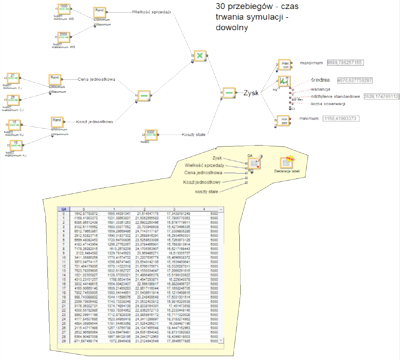 Professor Zabawa presented two 90-minute lectures in IEZ1532 on the use of ExtendSim, teaching students how to read and analyze models, plus build their own models. As students have experience with other simulation tools, they are able to easily build ExtendSim models.
In the first lecture, issues related to continuous simulation based on the book by Prof. Bozena Mielczarek were discussed. Using an example of a simple financial model, he also presented a technique for storing the results from multiple runs in tables to demonstrate Monte Carlo simulation using the following model assumptions:
-
- sales volume (uniform distribution)
- unit price (uniform distribution)
- unit cost (uniform distribution)
- fixed costs (Constant block)
Results of the model showed:
-
- Financial profits: saved in arrays across the runs
- Financial profit: maximum, mean, variance, standard deviation, number of observations in a single run
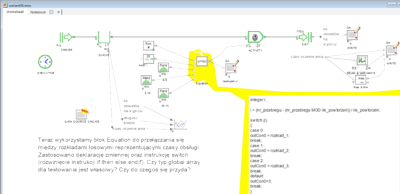 In the second lecture, he discussed discrete event simulation in Extendsim. He focused his presentaiton on the possibility of saving the results from multiple runs (Write blocks) and controlling the parameters of the Activity block describing the following approaches:
-
- using Select Value In with the Constant block
- using Select Value In accompanied by Equation and Simulation Variable blocks
- using the Equation block accompanied by Simulation Variable, Constant and Random blocks
Also discussed was the use of ModL language elements in the Equation block (for example: MOD and Switch instructions). Plus, the application of sensitivity analysis using Sensitize Parameter and Read from column x of file.
Click here to see a sample of the model used in 2022 courses and quiz questions presented to students.
ExtendSim use in 2021
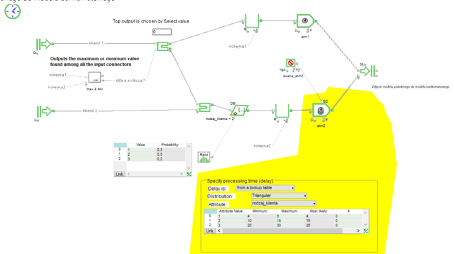 During the classes in which I used ExtendSim (compared to the previous year) I added a model in which I presented a way to implement the assumptions about the 2 automated teller machine operating system. We assumed there were two customer streams. In the first stream of people (client 1) the client selects this ATM (atm1 or atm2) to which there is a shorter queue – I presented the use of blocks Max&Min, Select Item Out (control via connector Select). In the second stream of people (client 2) can only use atm2. In addition, I showed how to model the failure of the ATM (Shutdown block). I also presented setting numeric attribute values (rodzaj_klienta; Set and Random Number blocks) and used attribute values to control random time distribution parameters (in Activity block).
After each meeting with students, I checked the acquired knowledge by collecting answers to sample questions, such as:
- Which block is used to model service stations?
- How can you model a case in which the distribution of servie time at the server depends on te value of the specified attribute but the distribution type is always the same?
- What information can we get from the History block?
How ExtendSim typically is used in the course
This software was used as a primary modeling tool for continuous and discrete event-simulation software. Students build a simple model on their own and work in teams of two to build a model based on assumptions.
Student projects
It depends on the number of the course hours. During the course of 10 hours, students develop a model based on the assumptions in the form of text using a graphical representation of the model (in the Extendsim notation) and complement the model with the ability to record the results of several runs.
During the course of 15 hours, students develop two models for an evaluation. First, on the basis of the assumptions in the form of text, and using the graphical representation of the model (it is kind of a test designed to realize the student's skill level). Then prepare a complete model based on assumptions and graphical representation other than Extendsim). It is a task carried out in groups of two students.
Ease with which students learn to model with ExtendSim
Very fine, easy GUI, input and output connectors, easy handling of attributes.
Benefits attained through the use of ExtendSim
ExtendSim is powerful software in which we can build very complex models, develop our own library of blocks, and it has good integration with external data. We also appreciate its:
- Easy handling of attributes and their processing.
- High correspondence between the model and the structure of the process.
- Hierarchical blocks.
2020 - aspects of building models of discrete event systems presented in the course
MODEL 1
The simplest model consistent with the discrete (queuing) approach. The possibility of displaying charts was also presented.
MODEL 2
The simplest model equipped with the ability to save the results of many experiments and simple statistical calculations.
MODEL 3
Automatic sensitivity analysis and the possibility of cloning interior windows.
MODEL 4
Controlling the length of service time using an external RANDOM NUMBER block and connector D at the service station (ACTIVITY).
MODEL 5
Presentation of using the SELECT ITEM OUT switch to direct objects that do not fit in a queue to another place. Note the impact of this solution on the simulation results.
MODEL 6
Model extension with a preparatory service module. It was shown how to combine two streams, how to declare attributes and their values, how to check the values of attributes in a selected place of the model, how to draw a path for objects.
MODEL 7
Presentation of static attribute attribution (in the path all objects will have the same attribute value). You can also see in the HISTORY block the simultaneous possession of two different attributes by a given object (attributes: color and I_STep = yes / no).
MODEL 11 The completion (batching) technique was presented. In batching, we combine objects (it can come from different sources) and treat the rest of the model as a whole. However, objects can be separated at the selected place in the model. An example of using the batching technique is modeling employee participation in material processing.
Sample of ExtendSim usage in past courses
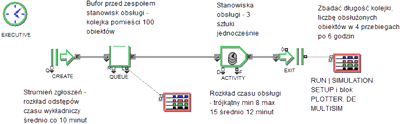 LESSON 1
Create an input stream in which the exponential time between arrivals is, on the average, 10 minutes. Set up a buffer that can accommodate a queue of 100 objects for a set of service stations. Each station can process 3 objects at the same time. Service time is a triangular distribution with a minimum of 8, maximum of 15, and average of 12 minutes. Check the length of the queue when the model is run 4 times for 6 hours each.
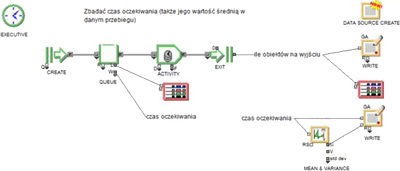 LESSON 2
Using Global Arrays and Named Connections, take note of the number of objects output at the end of each of the runs, the final waiting time in the queue, and its average value.
LESSON 3
There are four types of items (A, B, C, & D) requiring prep work prior to servicing. Types A, B, & C are generated on an average of one every 10 minutes on an exponential distribution. The likelihood of each type being generated is:
30%
40%
30%
Type D is generated one every 10 minutes. Tip: Store information about each item’s type as a 'Type' attribute.
Prep work servicing for types A and C is performed on 3 dedicated servers. Prep time is a triangular distribution of between 5 and 10 minutes with 8 being the highest probability. Priority prepping is given to type A items.
Prep work servicing for types B and D is performed on 2 dedicated servers. Prep time for type B is a triangular distribution of between 5 and 10 minutes with 8 being the highest probability. Prep time for type D is a triangular distribution of between 5 and 14 minutes with 8 being the highest probability.
Determine how many items are generated by the system and how many of each type. 
Tip: Use Information (Item), Select Item Out (Item), and Select Item In (Item) blocks in addition to the Data Source Create and Write blocks.
LESSON 4: Batching
There are four employees at the workshop. Unless there is an employee available, service at any station cannot begin or end. At the end of each service activity, employees rest up and begin to get acquainted with the next activity at their station (this process takes 10 minutes). As the most valuable resource, the employee is only called into service with the item they will be working on is available for service.
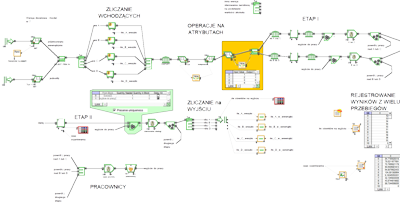 Are four employees enough to maximize productivity? Or should the company hire more? Or would a reduction in staff be more beneficial?
Additionally, ExtendSim has been used in the following course
Business Modeling and Forecasting
Jacek Zabawa
How ExtendSim typically is used in the course
I introduced the experiment (a change in the way the classes). At the first session I showed (and students to repeat) how to build a very simple queuing model equipped with the ability to record the results of multiple runs (blocks a write). At the second class I presented high degree of complexity model (service attributes, batching, recurrences of objects). At the third class I presented sets of simple models which implement (separately) service attributes and batching. These models were gradually expanded. Students build simple models and then expanded them. At the next class (in January) will be a single test, performed independently, consisting of self-construction of a simple model based on the assumptions of text. I'll put the suggestions (hints) on the types of blocks that can be used. Before the test I'll do recap material. At the last class students who do not pass the test will be able to fix it. For those who have passed positively I would like to present other advanced capabilities Extendsim, perhaps it will be genetic optimization or sensitivity analysis.
Additionally, ExtendSim has been used in the following course
Financial Analysis of Company Appliations with Models
Jacek Zabawa
How ExtendSim typically is used in the course
It consisted of a lectures and seminars. During lectures I presented, among others, new edition of complete application in Extendsim allowing construction of financial statements (balance, incomes etc.). As in the previous year we also discussed its modules, such as the calculation of income and expenses for this activity-based costing. We tried to use the models for business game support.
In the seminar portion of the course, students created financial simulation models of selected economic games. Here, the tool was arbitrary, but some groups chose to implement their model in ExtendSim - due to the readability of models created in ExtendSim was particularly didactic.
Preparing for this course inspired Prof. Zabawa to prepare another paper in to formulate a methodology of modeling assumptions in financial simulations. This methodology is based on the multiplication of objects: one object for "things" and second object for "money". "Integrating discrete event simulation and financial reporting" was accepted for publication and it was presented during the 33rd International Conference Information Systems and Technology Architecture.
I used the previously improved structure of the lecture with several recordings (movies snap) on how to create models. I have presented different models for the problem of "improving equipment" and how to study the impact of such change on the financial statements. As in the previous year, we dealt with economic events "prepayment" and "delay in payment of liabilities and receivables". I also presented the design and calculation techniques of balance statement using yogurt production model that was included in the package ExtendSim.
Conference papers submitted based on Prof. Zabawa's projects
Zabawa, J. (2024). How to Facilitate Hybrid Model Development by Rebuilding the Demographic Simulation Model. In: Franco, L., de Mulatier, C., Paszynski, M., Krzhizhanovskaya, V.V., Dongarra, J.J., Sloot, P.M.A. (eds) Computational Science – ICCS 2024. ICCS 2024. Lecture Notes in Computer Science, vol 14834. Springer, Cham. https://doi.org/10.1007/978-3-031-63759-9_21.
Abstract: Demographic information can be used to analyze processes occurring in a wide range of human social activity: in the area of management, healthcare, social security systems. One of the leading methods of demographic modeling is continuous simulation based on the system dynamics approach. Reducing computation time for fast-running continuous model implementations enables efficient development of hybrid models. In the hybrid simulation model, the discrete-event simulation approach was used as one of the components. Technical and conceptual solutions to the observed problems were presented, experiments based on demographic data from the Wrocław region, Poland were performed and it was indicated that an effective hybrid simulation will allow to include additional cause-and-effect relationships in the models.
Jacek Zabawa, Bozena Mielczarek (2021). An attempt to replace system dynamics with discrete rate modeling in demographic simulations. W: Computational Science - ICCS 2021 : 21st International Conference Krakow, Poland, June 16-18, 2021 : proceedings. Pt. 4 / eds. Maciej Paszynski [i in.]. Cham : Springer, cop. 2021. s. 269-283. (Lecture Notes in Computer Science, ISSN 0302-9743; vol. 12745) DOI 10.1007/978-3-030-77970-2_21.
Abstract: The usefulness of simulation in demographic research has been repeatedly confirmed in the literature. The most common simulation ap-proach to model population trends is system dynamic (SD). Difficulties in a reliable mapping of population changes with SD approach have been howev-er reported by some authors. Another simulation approach, i.e. discrete rate modeling (DRM), had not yet been used in population dynamics modelling, despite examples of this approach being used in the modelling of processes with similar internal dynamics. The purpose of our research is to verify if DRM can compete with the SD approach in terms of accuracy in simulating population changes and the complexity of the model. The theoretical part of the work describes the principles of the DRM approach and provides an overview of the applications of the DRM approach versus other simulation methods. The experimental part permits the conclusion that DRM approach does not match the SD in terms of comprehensive accuracy in mapping the behavior of cohorts of the complex populations. We have been however able to identify criteria for population segmentation that may lead to better re-sults of DRM simulation against SD.
Zabawa J. (2020) "Simulation Approach in Queue Management at Supermarkets in the COVID-19 Era". Presented at the 35th IBIMA Conference, Seville, Spain. 1-2 April 2020.
Abstract: How to prevent and control of epidemic spreading of diseases (for example COVID-19) in supermarkets? To answer this question, a simulation approach was proposed. A number of simulation experiments were performed. The likelihood of close contact with carrier in different ticket queue configurations was compared. Based on the results, several tips and suggestions were developed for customers and market managers.
Mielczarek B., Zabawa J. (2018) "Modelling Population Dynamics Using a Hybrid Simulation Approach: Application to Healthcare". In: Obaidat M., Ören T., Merkuryev Y. (eds) Simulation and Modeling Methodologies, Technologies and Applications. SIMULTECH 2016. Advances in Intelligent Systems and Computing, vol 676. Springer, Cham, cop. 2018. s. 241-260
ISBN 978-3-319-69831-1
Abstract: The goal of the study is presenting a population submodel developed using the system dynamics (SD) approach and discussing solutions for the integration of the SD methodology with discrete time control in formulating long-term projections for population evolution and its influence on healthcare demand. This study relies on historical demographic data and officially formulated scenarios for the most likely population projections for the Wrocław Region. The historical parameters are applied from 2002 to 2014, and projected trends are adopted for 2015 to 2035. The preliminary findings confirm the validity of using the hybrid simulation approach for a more advanced exploration of demography-dependent health policy issues.
Bożena Mielczarek, Jacek Zabawa. "Simulation model for studying impact of demographic, temporal, and geographic factors on hospital demand". Winter Simulation Conference, 2017
Abstract: This paper reports on the results of a study that aims to develop the hybrid simulation model for estimating the level and structure of the demand for healthcare services. Research is performed for the Wrocław Region (WR), the main administrative area of Lower Silesia, the fourth largest province in Poland. An aging chain approach is implemented in the system dynamic model to forecast the number of individuals belonging to the respective age-gender cohorts over the next 20 years. The discrete event simulation model predicts the expected volume of emergency arrivals at the WR hospitals and explores the relations between demand and demographical, temporal and geographical aspects. The projections of long-term population evolutions are performed on the aggregated data and analysis is focused on pre-specified age-gender cohorts. The demographic groups are described using parameters such as birth and death rates, life expectancy, and migration descriptors. The historical data on hospital admissions are drawn from National Health Fund regional branch registry. Findings have important implications for the future decisions on distributions of the resources on the regional level.
Bozena Mielczarek, Jacek Zabawa. "Modelling Population Growth, Shrinkage and Aging using a Hybrid Simulation Approach: Application to Healthcare". SIMULTECH 2016: 75-83
Abstract: This paper describes a hybrid simulation model that integrates the System Dynamic approach with discrete time control to formulate the projections of population evolution. The study relies on historical demographic data and the officially formulated scenarios for the most likely population projections developed for the region. The results of the simulation experiments provide valuable insights into dynamics of regional demographic trends and offer a well-defined starting point for future research in the health policy field. The intensity and structure of the demand for healthcare services depend heavily on age-gender profiles that change due to ongoing extensions of the average expected length of life, the aging of population, the continuing trend of declining number of births and the steadily growing number of deaths. The preliminary findings show promise in using the hybrid simulation approach for more advanced exploration of demography dependent health policy issues.
Bozena Mielczarek, Jacek Zabawa. "Modeling Healthcare Demand Using a Hybrid Simulation Approach". Winter Simulation Conference 2016.
Abstract: This paper describes a hybrid simulation model that uses a system dynamics and discrete event simulation to study the influence of long-term population changes on the demand for healthcare services. A dynamic simulation model implements an aging chain approach to forecast the number of individuals who belong to their respective age-sex cohorts. The demographic parameters that were calculated from a Central Statistical Office Local Data Base were applied to the Wroc?aw Region population from 2002 to 2014, and the basic scenario for the projected trends was adopted for a time horizon from 2015 to 2035. The historical data on hospital admissions were obtained from the Regional Health Fund. A discrete event model generates batches of patients with cardiac diseases and modifies the demand according to the demographic changes that were forecasted by a population model. The results offer a well-defined starting point for future research in the health policy field.
Jacek Zabawa, Edward Radosinski. "Comparison of discrete rate modeling and discrete event simulation. Methodological and performance aspects." Published in Springer's book series: Advances in Intelligent Systems and Computing
Jacek Zabawa. "Discrete rate modeling approach for supply chain modeling" Presented at the Total Logistic Management Conference 2015 and published in the Czasopismo Logistyka journal in 2016.
Abstract: The paper discusses the basics of modeling inventory management system in a spreadsheet. Then the application of a discrete rate in the supply chain simulation was proposed. Assumptions of test models which utilize DRM was presented. The structure of models and specification requirements was proposed. Selected simulation experiments were performed. The results were analyzed in a specially designed spreadsheet tool. Conclusions and prospects for further research was presented.
Bozena Mielczarek, Jacek Zabawa, and Marek Lubicz. "A System Dynamics Model to Study the Impact of an Age Pyramid on Emergency Demand." In Proceedings of the 4th International Conference on Simulation and Modeling Methodologies, Technologies and Applications, 879-888, 2014, Vienna, Austria
Abstract: This paper describes a system dynamics simulation model to analyse the relationship between age pyramid and the volume of patients arriving to hospital emergency departments located in a sub-region of Lower Silesia of Poland. The study relies on demographic and historical demand data, and the cohort forecasts for the population of the region. The results of the simulation experiments provide insights into the relationship between sub-regional demographic trends and population needs in relation to hospital emergency arrivals. The preliminary findings indicate that the forecasted long-term demographic changes in the population may increase the number of emergency patients in the area.
Zurich University of Applied Sciences (ZHAW)
 School of Engineering
Institute of Data Analysis and Process DesignWinterthur, Switzerland
Course ExtendSim is used in
Simulation of Business Processes
Traffic System Operation
Professor Manuel Renold
Type of course
60 to 75 advanced and professional students in various classes
How ExtendSim typically is used in the course
The SoBP course is an introduction to discrete event simulation. Its goal is to teach the basic concepts of discrete event simulation then have students apply these concepts to practical problems.
The first four weeks of this course are a technical introduction to ExtendSim (libraries: Item, Value, Chart). For the rest of the course, ExtendSim is used as the workhorse for many applications and exercises that are built around the conceptual concepts taught. Students model assembly lines, passenger simulations, and optimization problems (GA-Optimizer is very helpful).
Student projects
- Used for Bachelors and Masters Theses
- Airport simulations
- Passenger flows
- Optimization of passenger processes
- Security lines
- Migration controls
- Airplane taxiways
- Runway capacity
- Air traffic flow (TSO)
Ease with which students learn to model with ExtendSim
Version 10 is a great improvment!!! Students program and construct their own modules and interfaces. The documentation is very inuitive. I use it sometimes instead of my lecture slides.
Benefits attained through the use of ExtendSim
At the beginning, I used ARENA and Simulink but Extendsim is more intuitive and I see better results in seminar works and exams. (Important: I don't say that because of this questionaire!)
Will you be using ExtendSim in future courses?
Yes. I will use in courses like Traffic System Operation (Bachelor Aviation course) and Simulation (Module in a Masters course for Aviation Master students).
Anything else you would like to add?
Due to the use of Extendsim in my course, Beeing/Aurora Aerospace and Laser Enterprise bought a licence. Swiss Post will follow soon!